To support this site, please make your purchases through my Amazon link.

Thursday, March 31, 2005

A Conversation with Hugh Hewitt

I just got back from the speaking engagement of conservative talk radio host/blogger/law professor who was speaking at Claremont McKenna College. Very interesting stuff.

The most important thing I took from the talk was the importance of keeping an ear out for what the other side is saying. All too often I get stuck listening to people who agree with me without realizing there are quite a few people in this world who don't.

A great deal of the audience was conservative -- something rarely seen at the Claremont Colleges (even at the purportedly conservative CMC) -- and so I got to hear a number of talking points I had not yet been familiar with. A number of the people at my table, for instance, seemed to believe that Michael Schiavo was lying about his wife's sentiments, though they wouldn't say so outright.

Hewitt was extremely interesting in talking about the proliferation of the new media. Although I fundamentally disagree with him on many of his political conclusions, I was surprised to find that I agreed with him at times.

A few of things stuck out to me. Hewitt listed the five founding myths about blogs, some I agreed with, some I didn't. They were:

  1. The Trent Lott Scandal (the reporting of Jonah Goldberg and Josh Marshall)
  2. Howell Raines at The New York Times (losing his job on account of the Jayson Blair issues, and specifically blogs' commentary on it)
  3. John Kerry's Swiftvet Issues (bloggers proved some of their claims to be true, thus allowing the media to listen to them)
  4. Rathergate (the debunking of forged documents)
  5. Eason Jordan at CNN (being forced out by blogs' reports of his comments in Switzerland)
Although I don't entirely agree with all of his points (Trent Lott lost his job because Bush no longer wanted him, though Marshall and Goldberg played a role, for example) and disagree with his omission of Jeff Gannon/James Guckert, it was interesting to hear how the other side thinks about the blogosphere.

During the Q&A session, I asked Hewitt about the success of Air America (how it has grown from three stations to 51 in a year, how it is outperforming rightwing radio in places like New York). His response was that Air America is "bad product" and it "won't last long." "It will ultimately fail." I fundamentally disagree with the conclusions Hewitt draws about Air America but he raised an interesting point. Air America isn't necessarily bad product in comparison with right wing talk radio (although I assume he believes it is); Air America is bad radio compared to NPR, which draws northwards of 20 million listeners each week. If Air America fails in the future -- I don't believe it will, though -- but if it does indeed fail, Hewitt's explanation that it loses to NPR, not Rush, will probably be correct.

After the talk and the Q&A, I went up to Hewitt and introduced myself. "Oh, the Air America guy!" I explained to him that he had assailed me in his blog two weeks earlier, though he had said he had just linked to me (which is probably closer to the truth). We talked a bit more about Air America -- I tried to rebut a few of his claims, he said he was bumped off the air in Eugene in favor of Air America -- and I gave him the info on my blog. It sounds like I have a shot at being assailed (or linked to) by Hewitt in the future -- perhaps even tomorrow -- and that's moderately exciting.

I'm Off to See Hugh Hewitt

It's not often that I have the opportunity to see a right wing talk radio host cum blogger like Hugh Hewitt, but tonight seems to be the night. You might remember that two weeks ago Hewitt used me as an example of a naive Democrat who believes that the Democrats should push through the nuclear option:
Reid is not without his supporters. There is college student Basie [...] who is buying into the argument that the Democrats have a mandate to block judicial appointments [...] I hope that Senator Reid or some other Democratic spokesperson embraces it on a national platform, as the laughter that follows would be enormous.
It should be an interesting evening, so check in later on tonight for a brief account of the talk (and my probable question or two for him).

A Good Day for Neocons, a Bad Day for Neocons

What do you do to a man who was the strongest proponent of a war that has since been proved to have been based on faulty and fixed intelligence? If you're Lyndon B. Johnson or George W. Bush, you evidently promote that man to head the World Bank. Reuters has the story:

Paul Wolfowitz, known worldwide as an architect of the U.S. invasion of Iraq, was approved as the World Bank's new president on Thursday.

His nomination by President Bush was sealed in a unanimous vote by the World Bank's 24 executive directors, the bank confirmed.
This hasn't been the best week for every neocon, though. Don Fasnacht of the Richmond Palladium-Item reports:

A well-aimed pie tin filled with goop delayed, but failed to derail, an otherwise civil dialogue on U.S. foreign policy at Earlham Tuesday evening.

Neoconservative journalist and commentator William Kristol was about 30 minutes into his speech on international affairs when a slender young man crossed the stage of Goddard Auditorium and slung the ersatz pastry into his face.

Kristol appeared momentarily stunned, then wiped the brown and white goo from his eyes with a paper towel, stepped back to the podium and said, "Let me just finish this point."
Ouch.

Save The Filibuster!

Taegan Goddard passes on one of the best new ads in a long time.


People For the American Way Foundation has launched a new phase of our emergency campaign to save the filibuster. We’re sounding the alarm and mobilizing Americans to stop far-right leaders in their tracks.

Senator Frist’s “nuclear option” scheme relies on a bogus procedure that would need the backing of 50 senators. We need at least six Republican senators to stand up for checks and balances. Fortunately, many Republicans have deep misgivings about the nuclear option. They know it would damage the Senate and violate basic principles of American democracy.

The vote is too close to call. We can defeat the nuclear option if we get our message out.

Our ad is designed to secure the needed Republican votes against the nuclear option. It features a clip from Mr. Smith Goes to Washington, the movie classic in which the protaganist used the filibuster to stand up to corrupt forces in the Senate. The ad also features a Republican firefighter saying America works best when no one party has absolute power. Polls tell us that a huge majority of Americans agrees with this message.

Our goal is to reach and mobilize millions of common-sense constituents of key Republican senators. The first wave of ads has launched in Arizona, Nebraska, Maine, New Hampshire, Oregon, Virginia, Indiana and Kansas, as well as on several national outlets.
For more information, visit SaveTheFilibuster.org.


Click here to buy the Frank Capra
classic Mr. Smith Goes to Washington

Will Robert Byrd Seek a 9th Term?

Last month, Sen. Robert Byrd, the 87 year old West Virginia Democrat, began to publicly discuss a reelection bid. Byrd, the oldest current member of the Senate, will break Strom Thurmond's record of 48 years in the Senate next year, and is one of the wisest parliamentarians in the history of the chamber. About two weeks ago, leading Democrats called on supporters to begin to raise funds for Byrd should he decide on a bid for a 9th term. Now, as Paul J. Nyden reports for the Charleston Gazette, Democratic activists have done just that -- and more.

Early Tuesday afternoon, Sen. Barack Obama, D-Ill., sent an appeal over the Internet urging people to contribute to the re-election campaign of Sen. Robert C. Byrd, D-W.Va.

In less than 24 hours, more than 15,000 contributors gave $634,000 to Byrd’s campaign, according to the National Journal’s daily Internet publication “Hotline.” The average donation was about $42.25.

In Obama’s appeal, sent out by the MoveOn Political Action Committee, he wrote, “In 2006, Senator Byrd will be the target of Republicans because he stands up for what he believes. Will you join me in supporting Senator Byrd’s campaign for re-election, before a critical deadline this Thursday?”

Obama told The Charleston Gazette on Wednesday, “Sen. Byrd has spent his career in the Senate standing up for the Constitution and putting principle over politics. The people of West Virginia are lucky to have such a distinguished and powerful advocate fighting for them who consistently delivers results.”
Do you think $634,000 in one day might help sway Byrd's decision?

Air America Continues to Shine

In Oregon, and across the nation, Air America Radio is growing and expanding. What was once a small network servicing three cities just a year later reaches 51 -- including three in Oregon alone. Kristi Turnquist of The Oregonian reports on the success of one of Air America's flagship stations, KPOJ Portland.

"They said we wouldn't last, and we're still here," says Mike Dirkx, operations manager for KPOJ (620 AM).

It was exactly one year ago today that the Portland station started carrying programming from Air America, the liberal talk-radio network that has inspired criticism, praise and predictions of doom. But the Portland station hasn't just survived; it's become a national model for how to carry off the still-evolving "progressive talk" radio format.

Since switching from an oldies music lineup to progressive talk, KPOJ has moved into the top 10 most-listened-to stations locally. "We went from a 0.4 rating to a 3.7, and that's a pretty substantial jump," Dirkx says of the latest Arbitron ratings, for fall 2004. "It's the most successful progressive talk station going right now."
The key point of this article is the fact that although there were dozens of articles across the country lampooning Air America's effort -- claiming that it would die within weeks -- the network has continued to grow at a remarkable pace over the last twelve months.

Apropos to the Turnquist article, although Portland is indeed a "liberal" city, the success of the station -- increasing its listenership by more than nine times in just a year -- is proof that progressive talk radio can overcome the odds and knock Rush and Hannity off of their pedestals.

Quote of the Day

Craig Ferguson, on the Pat O'Brien sex tapes:

"His reputation has taken such a hit, that someone saw him on the street today and yelled, 'hey, there's Bill O'Reilly!'"
Link.

Senate GOPers Offer Luke Warm Support for Privatization

There are very few moderate Republicans left in the Senate, and on budgetary matters -- where only 50 votes are necessary for passage -- their voices alone don't matter (as we saw this year with ANWR, the minimum wage, etc.). Nevertheless, on normal votes where 60 votes are necessary for passage, their support is crucial for the GOP. So when two Republicans voice their qualms about the Bush Social Security plan, it's highly meaningful. Kelley Bouchard has the first story on Senator Olympia Snowe (R-ME) for the Portland Press Herald:

Speaking during a roundtable discussion at the AARP office on Congress Street, Snowe said that diverting 2 percent to 4 percent of Social Security payroll taxes to personal accounts would undermine the basic premise of the program.

She said Social Security has worked "exceptionally well" for more than 70 years and is expected to be funded until 2042. She called for a fact-based initiative to inform Americans of all ages about Social Security and develop solutions to the problems it faces.

[...]

Letters, calls and faxes to Snowe's offices on the issue of private investment accounts have run 6,897 against and 188 in favor since the president's inauguration. Many of her constituents are overwhelmed with anxiety at the prospect of losing some of their benefits, she said.
Even Sen. Lisa Murkowski (R-AK), usually a lackey for the administration, is showing some qualms about the Bush plan. Nicole Tsong of the Anchorage Daily News reports:

As President Bush made the case nationwide to add private investment accounts to Social Security as part of a system overhaul, U.S. Sen. Lisa Murkowski said Tuesday she would consider his proposal as an option.

But that plan alone "is not sufficient" to provide full benefits to all recipients, she said.
At this point in the game -- halfway through the 60-day bamboozlepalooza tour -- President Bush needs to be attracting supporters, not hemorrhaging them.

Wednesday, March 30, 2005

Talk About Fuzzy Math!

The New York Times' Edmund L. Andrews does a masterful job of reporting on the effort to debunk the President's faulty economic models, upon which the Bush privatization scheme is based.

In barnstorming the country over Social Security, administration officials predict that American economic growth will slow to an anemic rate of 1.9 percent as baby boomers reach retirement.

Yet as they extol the rewards of letting people invest some of their payroll taxes in personal retirement accounts, President Bush and his allies assume that stock returns will be almost as high as ever, about 6.5 percent a year after inflation.

[...]

Many believe that stock returns will be lower than they have been in the past, closer to 5 percent than 6.5 percent, and that returns on a balanced mix of stocks and bonds will be much lower than that.

[...]

Under Mr. Bush's plan, moreover, people would need to earn at least 3 percent a year after inflation just to make up for automatic cuts in traditional Social Security benefits.

In a paper to be presented on Thursday at the Brookings Institution, three economists who are longtime critics of Mr. Bush argue that stock returns are likely to be about 4.5 percent if economic growth slows as much as the administration predicts.
If these models are correct -- and they most likely are because they have not been skewed by pro-administration lackeys -- and there is 4.5% average growth in the stock market rather than 6.5% average growth, a substantial number of Americans (20%-32%) will fare worse under the privatization scheme.

The American people aren't willing to bet their retirement fund for a one in three chance that they will earn a little more money. It's that simple. Until the President realizes this, there is no way he is going to win over the American people.

Bonus Quote of the Day

"When the fervor of political passions moves the executive and legislative branches to act in ways inimical to basic constitutional principles, it is the duty of the judiciary to intervene. If sacrifices to the independence of the judiciary are permitted today, precedent is established for the constitutional transgressions of tomorrow."

-- Judge Stanley F. Birch Jr., a Bush 41 appointee "who has a reputation as consistently conservative," on the legislative wranglings by President Bush and the Republican Congress in the Terri Schiavo case
Link.

DeLay Defenders Jump to Action

Facing the prospect that Tom DeLay might be forced out of office, a group of powerful conservatives has banded together to protect their ethically-challenged House Majority Leader. Mike Allen has the story for The Washington Post:

House Majority Leader Tom DeLay (R-Tex.) challenged his liberal critics yesterday to "bring it on," as major conservative groups organized a formal defense against questions about DeLay's ethical conduct.

The groups -- led by David A. Keene of the American Conservative Union and including the Heritage Foundation, Leadership Institute and Family Research Council -- met privately with DeLay last week and pledged to use their grass-roots databases and networks to try to mitigate the damage from news accounts of DeLay's travel and relationships with lobbyists.

The groups have talked about holding a salute or tribute dinner for DeLay, with the proceeds benefiting a children's charity not associated with the majority leader. [emphasis added]
Allen scores a bit of humor in that last sentence as Tom DeLay has gotten in trouble in the past for raising funds for children's that don't always benefit needy children. Nice work, Mike.

DeLay Demise Nearing?

Howie Fineman, a veritable bellweather of national sentiment, seems to believe so.

A new drama of survival has begun here – political, not physical; legal, not spiritual. The central character isn’t a woman in a hospital bed but a controversial Republican leader in the House of Representatives. Rep. Tom DeLay may not want to admit it to himself, but he’s fighting for his political life.

I wouldn’t have said so two weeks ago. But I’ve seen enough of these dramas unfold to know when I’m watching a new one, and now I am. You know the story line, which dates back to the Greeks: a powerful, hubristic leader is brought low by his own flaws. Think Jim Wright, Newt Gingrich, Bill Clinton.

A key but cautious leader of the Republican leadership put it to me this way in private recently: “Members want us spend our time protecting them. They don’t like having to spend their time protecting us.” Meaning: their idea of fun and productive use of time in the capital is not “DeFending DeLay.”
Christy Hoppe adds fuel to the fire with a story in today's issue of The Dallas Morning News detailing the most recent developments in the investigation of DeLay's political action committee, TRMPAC. Kos writes of the case,

Once this grand jury finishes its business, Earle is expected to convene the fourth grand jury on the matter targetting DeLay specifically. Rumors are already flying that those already indicted are singing in exchange for more lenient sentences. No one wants to rot in jail for DeLay's sake.
Sounds like things are beginning to move quickly in this matter.

Chafee Dodges Another Bullet in Rhode Island

First Jim Langevin drops out of the Rhode Island race. Now Patrick Kennedy, too? Apparently.

Rep. Patrick Kennedy, D-R.I., on Wednesday ruled out a run for the Senate in 2006, saying he could better serve his constituents by staying in the House and serving on the Appropriations Committee.

Kennedy has been in Boston caring for his mother, Joan Kennedy, who was hospitalized with a concussion and a broken shoulder after a passer-by found her lying in a street Tuesday.

In a statement, Kennedy did not cite family responsibilities as a reason for his decision, but he and his brother and sister recently took temporary guardianship of his mother to ensure she receives treatment for her alcoholism. Patrick Kennedy was seeking to become her permanent legal guardian.

"I am grateful for the support and encouragement I have received to run for the Senate," he said. "But over the past few days, I have determined that I can make the greatest difference in the lives of Rhode Island families by remaining on the Appropriations Committee in the House of Representatives and fighting for their priorities." The committee controls about a third of the nearly $2.6 trillion federal budget.
Polls had showed Langevin whalloping Chafee in a head-to-head matchup, and a run by Kennedy would have made Chafee's life extremely difficult. Secretary of State Matt Brown, the only Democrat left in the race, trailed Chafee by 14 points. Though former attorney general Sheldon Whitehouse, who has yet to enter the race, he fares little better than Brown. Linc Chafee, who just a month ago appeared to have a one-way ticket out of Washington, just might represent Rhode Island for another six years.

Quote of the Day

"I don't see the votes there."

-- Conservative Republican Congressman Lee Terry (NE), stating that the Bush proposal to partially privatize Social Security won't likely to get through Congress.
Link.

Battleground: North Dakota

The Hill's Peter Savodnik reports today on the latest battleground in the privatization war and the fight for the Senate in 2006: North Dakota.

When Treasury Secretary John Snow swoops into North Dakota tomorrow to discuss the politically fraught issue of Social Security reform, he’ll meet with business leaders, students and a handful of state lawmakers.

The one person he won’t be seen with is the most powerful politician in the state and a member of Snow’s own party: Gov. John Hoeven (R), who has yet to take a public position on what should be done about Social Security.

It’s not that Hoeven is against appearing with White House officials. He flew to North Dakota on Air Force One with President Bush after Bush gave the State of the Union address. He showed up with Agriculture Secretary Mike Johanns at a recent Republican dinner. And he’s scheduled to be with Johanns when he returns to the state in April.

The problem with Snow, Democrats in North Dakota and Washington say, is that he’s talking about the one issue Hoeven, who is considering a challenge to Sen. Kent Conrad (D) next year, would rather not talk about: revamping the nation’s retirement program in a state filled with retirees.

“I think that sending him in here is harmful to the Republicans,” said David Strauss, chairman of the North Dakota Democratic Party, referring to Snow. “I don’t think promoting the Bush privatization scheme has much positive political impact.”
Anyone believes that Kent Conrad is an easy target is nuts. It's not that North Dakota is a particularly progressive state, because it's not. In fact, Bush's 28-point margin was one of his largest in the nation.

The more important fact of the matter is that Kent Conrad is extremely popular in his state. As Savodnik notes,

Farmers, among the state’s biggest and most powerful constituencies, have generally praised both Hoeven’s and Conrad’s efforts to protect cattle ranchers from Canadian beef and to help the state’s thousands of corn, wheat and soybean farmers, among others.
It's more fundamental than this, though. When Kent Conrad first ran for the Senate in 1986 against incumbent Republican Mark Andrews, he pledged not to run again in 1992 if the deficit was not decreased. When it wasn't, he didn't run for reelection -- even though polls showed him to be a shoo-in -- and his seat was won by Byron Dorgan. For this honesty, among other things, North Dakotans are truly endeared to Conrad. As fate would have it, longtime Democratic Senator Quentin Burdick passed away that fall of 1992, and Conrad won his seat that December, thus remaining in the body.

Conrad's large campaign chest of $883,705 (as of the end of the year), combined with the paltry state of the NRSC under Liddy Dole, leads this blogger to believe that North Dakota won't quite as easy of a win as the GOP would like.

Tuesday, March 29, 2005

Bush's Privatization Plan Hits a Snag

It seems opponents of President Bush's plan to partially privatize Social Security are finally getting their act together. As Jeffrey H. Birnbaum reports on the front page of tomorrow's Washington Post, the AARP has amped up its ad drive to protect FDR's legacy.

In the punch-for-punch debate over Social Security, AARP is working hard to keep the White House on the ropes.

When President Bush arrives in Iowa today to talk up his private-accounts proposal, the senior citizens group plans to counter him with two news conferences, the release of a national poll, full-page newspaper advertisements and commercials on radio and television.

Over this week and last, AARP, the nation's largest lobby, will have spent more than $5 million on ads attacking the president's Social Security plan -- nearly three times as much as all the supporters of his proposal put together. That's just for starters.

Every state that has a swing-vote senator will have AARP forums, which have been drawing about 300 people each. And every time a member of Congress holds a town meeting, AARP volunteers are dispatched there to protest the president's plan for individual accounts.

"We're going to do this as long as it takes," said William D. Novelli, AARP's chief executive. "We will put just about everything we have into it."
Birnbaum, one of the finest reporters in the business, has a lot of interesting things to say in the article, so read on if you're interested. For now, I'd point you to the other major development in the the Social Security debate. The Hill's Bob Cusack has the scoop of the day: "Dems craft their own plan."

After months of criticizing President Bush on his Social Security reform plan, congressional Democrats are crafting their own retirement savings plan that does not call for any change to the entitlement system.

The Democrats’ move signals a shift in their strategy on Social Security. Until now, the opposition party has opted to lambaste Bush while declining to reveal its own ideas for encouraging saving.

Democratic senators on the Finance Committee this week quietly floated a document titled “Savings Options,” which sources say is designed to as a counter to Bush’s plan for personal accounts in Social Security. The document, obtained by The Hill, details several legislative possibilities, including a mandate on employers to provide payroll-deduction savings options for all employees.

It also tackles low-income incentives for saving by setting up accounts at birth in which the government would deposit $500 for each newborn and $1,000 for families with below-average incomes. The accounts would allow parents to contribute more money until the child turns 18, “with a government match for contributions from lower-income parents.” [emphasis added]
The contrast could not be better. Bush and the Republican Congress call for a plan to "fix" Social Security by partially privatizing it -- a move that would hasten the program's insolvency. The Democratic plan would fix Social Security without significant changes. Which plan do you think the American people support? I'll give you a hint.

Liberal Groups Begin Running Ads Against DeLay

It's about time the left got properly organized in the fight against Tom DeLay! The Democrats need a national wave against the GOP to retake the House in 2006, and the potential backlash against the misdeeds of the House Majority Leader could provide the necessary impetus for such a campaign. The New York Times' Glen Justice reports that the first round of ads are just beginning this week.

Two left-leaning groups intend to do just that [attack DeLay] in tough advertising campaigns that attack the majority leader and highlight the scandals involving former DeLay aides and advisers.

The Campaign for America's Future, which is calling for Mr. DeLay's resignation, is spending about $75,000 to run commercials in the majority leader's home district in Texas. The advertisement opens with a man wearing cuff links and a Rolex watch walking down the stairs into a basement, where he begins washing his hands. An announcer ticks off cases surrounding Mr. DeLay as the figure tries harder and harder to get clean.

"Tom DeLay can't wash his hands of corruption by involving Congress in one family's personal tragedy," an announcer says, referring to Mr. DeLay's involvement in the Terri Schiavo case. "But Congress can certainly wash its hands of Tom DeLay."

The Public Campaign Action Fund is spending $25,000 to pressure Republican lawmakers to denounce Mr. DeLay. Those targeted include Representative Doc Hastings of Washington, the chairman of the Ethics Committee, and Representative Thomas M. Reynolds of New York, who heads fund-raising for House Republicans.

The ad involving Mr. Hastings exhorts him to "do your job and clean up Congress without delay."
Let's hope this is just the opening salvo in the case against DeLay, not the peak of progressive involvement. Millions must be spent so the American people can meet Tom DeLay and learn what modern Republicanism is really about.

[Update 8:06 PM Pacific]: Mike Allen has more on the story in tommorow's issue of The Washington Post, if you're interested.

[Update 8:26 PM Pacific]: The Hill's Alexander Bolton has a couple of DeLay stories in the Wednesday issue of the paper. First, he provides in-depth coverage of the aforementioned anti-DeLay ads run by the progressive groups. In another interesting piece, Bolton reports on DeLay's 2004 -- and possibly 2006 -- opponent in Houston.

Richard Morrison, the little-known attorney who gave House Majority Leader Tom DeLay (R-Texas) a tougher-than-expected race last year, is traveling to Washington next week to meet with the Democratic congressional caucus.

Morrison announced his plans in a fundraising e-mail sent to supporters yesterday. The message announced a fundraising drive “with the goal of sending Richard back to Washington in 2006 as a Congressman!”

Morrison is looking for 100 sponsors for his trip to D.C., soliciting contributions between $10 and $100.

It’s already clear that Morrison would make ethics a big issue in a race against DeLay. His website features a slew of articles critical of DeLay’s ethics, including a March 28 Wall Street Journal editorial titled “Smells Like Beltway” that concludes: “Whether Mr. DeLay violated the small print of House Ethics or campaign-finance rules is thus largely beside the point. His real fault lies in betraying the broader set of principles that brought him into office, and which, if he continues as before, sooner or later will sweep him out.”

Morrison, an environmental and consumer rights attorney, lost to DeLay last year 55 percent to 41 percent.
It's good to see Morrison making such an early start to his campaign against DeLay. Bolton reports that the Democratic leadership has yet to agree to meet with Morrison. Let's hope they get their act together and realize that a man who held DeLay to 55% while being outspent 4.6:1 ($3,143,559 to $685,935) is the horse to bet on in the 2006 race.

R.I.P.

The New York Times' Robert Pear on Howell Feflin:

Former Senator Howell Heflin of Alabama, a conservative Democrat who supported civil rights legislation and was sometimes described as the conscience of the Senate, died on Tuesday at a hospital in Sheffield, Ala., near his home in Tuscumbia. He was 83.

His death was announced by his family.

Mr. Heflin, a large, bearlike man, was chief justice of the Alabama Supreme Court before he was elected in 1978 to the Senate, where he served for 18 years.

Fellow senators often called him Judge Heflin, referring to his probity and his judicious approach to issues. For 13 years, he passed judgment on his colleagues as a senior member or chairman of the Senate Select Committee on Ethics.
The Associated Press on Tom Bevill:

Former Representative Tom Bevill, a Democrat who became known as the King of Pork over three decades in Congress, died on Monday, his office said. He had turned 84 the day before.

Mr. Bevill, who had been in declining health since heart surgery last summer, represented what is now the Fourth Congressional District in north Alabama from 1967 to 1997.

He got his nickname for his ability to bring special projects into Alabama, and he played a major role in the building of the Tennessee-Tombigbee Waterway. He was chairman of the House Energy Development and Water Appropriations Subcommittee for eight years.
Carla Hall of the Los Angeles Times on Johnnie Cochran:

Johnnie L. Cochran Jr., the masterful attorney who gained prominence as an early advocate for victims of police abuse, then achieved worldwide fame for successfully defending football star OJ. Simpson on murder charges, died this afternoon. He was 67.

Cochran died at his home in the Los Feliz section of Los Angeles of an inoperable brain tumor, according to his brother-in-law Bill Baker. His wife and his two sisters were with him at the time of his death.

Cochran, his family and colleagues were secretive about his illness to protect the attorney's privacy as well as the network of Cochran law offices that largely draw their cachet from his presence. But Cochran confirmed in a Sept. 2004 interview with The Times that he was being treated by the eminent neurosurgeon Keith Black at Cedars-Sinai Medical Center in Los Angeles.

Long before his defense of Simpson, Cochran was challenging the Los Angeles Police Department's misconduct.

From the 1960s on, when he represented the widow of Leonard Deadwyler, a black motorist killed during a police stop in Los Angeles, Cochran took police abuse to court. He won historic financial settlements and helped bring about lasting changes in police procedure.
May each of these men rest in peace. Our thoughts and prayers are with their families.

The Ultra Right Cannibalizes a Conservative Senator

Lindsey Graham might be a realist on some issues, but there's no question that he's conservative throughout. For this reason, it's extremely interesting to see a fringe group on the right begin to run attack ads against him in his home state of South Carolina, as reported in National Journal.

Club for Growth President Patrick Toomey today announced his group is launching a 30-second television ad in South Carolina to criticize GOP Sen. Lindsey Graham's proposals to increase the cap on income subject to Social Security taxes. Graham supports a plan to raise the $90,000 cap on income subject to Social Security taxes to as much as $160,000. That money would be used to offset part of the transition cost to private accounts, estimated at between $1 trillion and $2 trillion. Toomey criticized Graham for trying to move the debate away from personal accounts. "We're very disappointed with Sen. Graham that we need a big tax increase ... and his recent comments that private accounts are a sideshow," he said.

Graham's office said in a statement that his opponents spent $3 million during the 2002 campaign targeting Graham's Social Security views. The Graham ad, which Toomey said would run for about two weeks, accompanies two other television ads the Club for Growth is launching in Nebraska and North Dakota to encourage Democratic Sens. Ben Nelson and Kent Conrad to support President Bush's plan to change Social Security. A Nelson spokesman said Nelson would not be influenced by outside advertising. He said Nelson's decision would be made based on the interests of Nebraska voters. "The senator has said he is open to private accounts provided they don't add to the deficit and they don't reduce benefits," the Nelson spokesman said. He said the ads are the first television spots on Social Security in Nebraska, adding AARP has run newspaper ads in the state.
The far right must be in dire straights if they have to secure the support of someone like Lindsay Graham (not to mention moderate GOPers like Chafee and Snowe, or conservative Dems like Baucus).

Josh Marshall notes the real third party action to watch in the Social Security debate will come on Thursday as thousands around the country will protest against bamboozlepalooza funders Charles Schwab and Wachovia.

Bush Knew "Everything" About the Kerik Matter

Shocking. Just shocking. President Bush knew that there was an outstanding warrant for Bernie Kerik's arrest. He knew that Kerik was using an apartment designated as a rest area for those cleaning up the World Trade Center for an extramarital affair. He knew that Kerik was alleged to have accepted bribes from mafiosos. So what did he do? He nominated Kerik to be the Secretary of Homeland Defense. Kerik discusses this, and more, with New York magazine.

Kerik, however, is adamant that he didn’t view accepting the Homeland Security nomination as taking a risk. “The process is ever-present in your mind; it’s always there,” he says, relaxing in a high-back, soft-green, tufted-velvet chair in a sitting area that’s off to one side of his office. “You worry about everything. But you know what you know and you think what you think. I have to live in the real world, and everything that’s come out is stuff I either told the White House about or they already knew.” [emphasis added]
The hubris of these guys still amazes me.

NY's GOP Falling Apart at the Seems

Although New York Republicans haven't been competitive on the Presidential level for decades, they have still been able to mount respectable showings on both the Congressional and statewide levels. 2006 might be the breaking point for them, as two reports today indicate. First, Newsday's Dan Janison reports that New York City's "Republican" Mayor is edging towards endorsing Democrat Hillary Clinton in the Senatorial race.

Republican Mayor Michael Bloomberg hinted strongly Monday night he would endorse Sen. Hillary Rodham Clinton next year for re-election -- aiming yet another Democrat-friendly signal at city voters.

"I think that I've said as many times as I could both Senator Schumer, the senior senator, and Hillary Clinton, the junior senator, have worked very hard and very effectively for New York City," he said.

[...]

Running in a mostly Democratic city, Bloomberg also declined to commit to Republican primary debates. Last week he distanced himself from the Republican party on the Terri Schiavo case, saying lawmakers shouldn't intervene.

Last year he endorsed Schumer for re-election.
The Republicans don't have a candidate to go up against Clinton yet, and even if they did, Mayor Bloomberg might not support him or her. NY GOPers have cause for concern on the gubernatorial level as well, as Fredric U. Dicker reports in the New York Post.

Gov. Pataki has decided not to seek another term next year and will concentrate instead on a bid for the vice-presidential nomination in 2008, a report last night said.

The New York 1 report — which cited unnamed "sources" saying the governor had told friends of his decision — was quickly denied by Pataki's chief spokesman, David Catalfamo.

"Claims that the governor has decided not to seek a fourth term are false," Catalfamo said.

Many leading Republicans, including Senate Majority Leader Joseph Bruno, have already predicted Pataki won't seek a fourth, four-year term next year, but the governor himself has indicated he wouldn't make an announcement until June.
Should the Democrats be able to take the statehouse and state legislature in 2006, watch for a possible mid-census redistricting effort in the state. It might not be the best decision in a policy sense, but the Republicans have left the Democrats with few alternatives.

Quote of the Day

"I've got too many skeletons in my closets for politics."

-– Angelina Jolie, as quoted by US Weekly
Link.


Blogger.com is in one of its funks again. I'll try to push through it, but please bear with me.

Supreme Court Reads Title IX Expansively

Today, the Supreme Court delivered a major victory for women's rights in Jackson v. Birmingham Board of Education. The AP's Hope Yen decodes the case for us.

The Supreme Court expanded the scope of a landmark gender equity law, ruling Tuesday that it shields whistleblowers who accuse academic institutions of discrimination based on sex.

The 5-4 decision in favor of Alabama high school girls basketball coach Roderick Jackson is a victory for women's advocates who say the legal protection will prompt reports of bias that would otherwise go unsaid or unheeded.

The ruling means Jackson can pursue a lawsuit claiming he was fired for complaining that the boys team received better treatment. Congress intended such lawsuits when it passed the Title IX law, justices said.

"Without protection from retaliation, individuals who witness discrimination would likely not report it, indifference claims would be short-circuited, and the underlying discrimination would go unremedied," Justice Sandra Day O'Connor wrote for the majority.

She was joined in her opinion by Justices John Paul Stevens, David H. Souter, Ruth Bader Ginsburg and Stephen G. Breyer.

The 1972 law, best known for promoting women's athletics, bars sex discrimination in any educational program receiving federal funds. It already was settled law that students or others could sue if they thought they were shortchanged based on their sex.

But the statute has been silent as to the rights of whistleblowers — regardless of gender — who aren't direct victims of discrimination but who claim retaliation. Since 1975, the federal government has interpreted Title IX to cover retaliation claims.
I am reminded of what former Senator Birch Bayh -- who wrote Title IX -- told me about the case last month:

Here you have Coach Jackson, who is a male basketball coach who happens to be black -- to put the scenario in the full context. Color has nothing to do with the issue; the fact that he's a man probably does, because here a man is asking his school board to do something about discrimination against his women students, his girls, and that to me is the way it ought to be done in the schools, communities throughout the country. Teachers stand up and say, "Hey, we have injustice going on here."

They, the Coach Jacksons of this world, are the symbols to alert the community generally that there's discrimination going on. You shouldn't have to sue somebody to get justice. It ought to come through administrative process. With the help of people like Coach Jackson to bring it to their attention, the School Board says "OK, we'll put a stop to this." Shouldn't have to sue them to get it done.

And to actually retaliate against Jackson, which compounds the problem here, to actually shoot the whistleblower, so to speak, I think is a major injustice. So I was glad to get involved in that.
He had much more to say about the case, so I highly recommend you check it out if you're interested.

Monday, March 28, 2005

Bush Carried 41 Dem. Cong. Seats in 2004

The Washington Post's Dan Balz reports that Polidata has completed the first analysis of Presidential voting trends by Congressional District for the 2004 elections. The results don't necessarily bode well for the Dems.

Only 59 of the 435 congressional districts went in different directions in presidential and House elections last year, according to newly released data from the political analysis firm Polidata. In the remaining districts, voters either backed both President Bush and the Republican House candidate or John F. Kerry and the Democratic House candidate.

[...]

Polidata's Clark Bensen said that Bush carried 255 congressional districts on his way to winning reelection last November, while Kerry won 180. The president captured 214 districts held by congressional Republicans and 41 districts that were won by Democratic House candidates. Just 18 of the districts that Kerry won are in GOP hands.

[...]

Bensen's figures show again the depth of the Democrats' problems in the South. Not only did Bush carry every southern state, he carried the overwhelming percentage of congressional districts, except those where minorities are in the majority. Bush carried 116 southern congressional districts, Kerry just 38. According to Bensen, just three House Republicans from the South occupy districts won by Kerry, while almost two dozen southern Democrats are in districts carried by Bush.
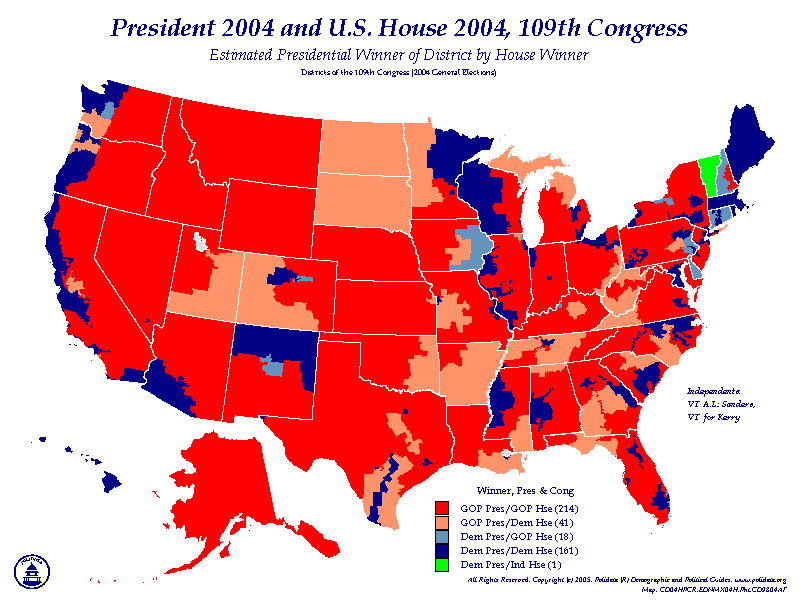

Although I don't believe the Democrats need to devise a "Southern strategy" in order to retake the White House, it's clear from this map that the 2008 nominee will have to do better in the region. Even more fundamentally, the nominee must be more competitive across the entire nation. Winning just 180 CDs just isn't going to cut it.

DeLay's Increased Profile Could be his Downfall

Last week we noted that Tom DeLay's large role in the Terri Schiavo case could hasten his fall. The Wall Street Jounral provided an early sign of wavering right wing support of the House Majority leader today, and CQ Weekly's Bob Benenson reports that the Democrats are waiting in the wings to pounce (no link available).

In recent campaigns, Democrats have sought to influence contests in competitive districts by portraying Republicans as right-wing extremists and Texas Republican DeLay as their mastermind, just as they did former Speaker Newt Gingrich of Georgia in the mid-1990s. But most voters have shrugged at the Democrats’ invocation of DeLay’s name.

[...]

Given DeLay’s political elusiveness over the years, some Democrats felt a bit of an adrenaline rush seeing him suddenly rushing into the national spotlight — even in a situation such as the Schiavo case that played so well among DeLay’s and the Republican Party’s social conservative base.

“A lot of us have felt over the past three or four years: Please put Tom DeLay on talk shows, get him out there,” said veteran Democratic strategist Peter Fenn. “Every time he does, our numbers go up.”
The Democrats should seriously consider devising a 50-state campaign against DeLay and Republican ethics problems for 2006. 50-state. Not 20-state.

Look at Wyoming, for instance, where Bush won by 40 points in 2004. Incumbent Republican Congresswoman Barbara Cubin was held to only 55% against a seriously underfunded candidate. If the Democrats can add a repulsion towards Tom DeLay to Wyoming's dislike of Cubin, there's a real possibility that a Democrat can win there in 2006. Try the same tactic in Democratic-leaning states like Connecticut and Illinois and they have a chance -- however small -- that they can retake the House.

Oy Vey!

A major earthquake struck off the west coast of Indonesia's Sumatra Island late Monday, and officials warned that a tsunami could strike the area. Residents of Banda Aceh fled their homes in panic.

The U.S. Geological Survey said the temblor, described by one of the agency's geologists as an aftershock of the devastating Dec. 26 quake, measured a magnitude of 8.2.
Link.

Our thoughts and prayers are with the millions living in the region right now. Let's hope the residents will have time to reach higher ground before a tsunami hits the area.

Hmm

From Hotline's Wake-Up Call!

Jack Kemp was seen Friday at the Bethesda Barnes & Noble buying "Why the Jews Rejected Jesus" (Wake-Up Call! sources)
Yes, the Jack Kemp who was the Republicans' Vice Presidential candidate in 1996. I don't quite know what to make of this

The Wall Street Journal Hammers DeLay

Who would have ever thought that the extreme right wingers over at the opinion page of The Wall Street Journal would ever be willing to disparage one of their own. Today it happened, though.

Taken separately, and on present evidence, none of the latest charges directly touch Mr. DeLay; at worst, they paint a picture of a man who makes enemies by playing political hardball and loses admirers by resorting to politics-as-usual.

The problem, rather, is that Mr. DeLay, who rode to power in 1994 on a wave of revulsion at the everyday ways of big government, has become the living exemplar of some of its worst habits. Mr. DeLay's ties to Mr. Abramoff might be innocent, in a strictly legal sense, but it strains credulity to believe that Mr. DeLay found nothing strange with being included in Mr. Abramoff's lavish junkets.
While I do not agree with their characterization of the situation -- they make it seem like DeLay has done no actual, they are correct to assert that DeLay epitomizes what's wrong with government. Perhaps some on the far right will begin to examine their fanatical defense of DeLay and begin to think hard about kicking him out of Congress and back into the bug business, where he belongs.

Further Evidence of Bush's Freefall

Another day, another poll. Today, it's Time's turn.

In the wake of the Schiavo case, President Bush's job rating had now dipped to 48% approve – 46% disapprove, down 5 points from last week. While the Schiavo case might have contributed to the decline, the Time Poll identifies other possible culprits, including record low ratings on Bush's handling of Social Security issues, down 6 points, to 31% approve – 58% disapprove. Even Bush’s handling of terrorism, long a core Bush strength, is down 11 points from last week, to 52% approve, 43% disapprove.

The poll finds some possible political fallout as well from the Congressional intervention. More than half (54%) would go as far as to say that they would be more likely to vote against their Congressman if he or she voted to move the Schiavo case to the federal courts.
There is important news for Oregonians in this poll as well.

A slim majority (52% - 41%) favor legislation allowing physician assisted suicide. Oregon is currently the only state that allows a terminally-ill adult to request a physician to administer a lethal dose of medication to end their life.
The Bush approval drop is unsurprising; every other recent poll has shown him drop 5-7 points this week. The Oregon numbers are particularly interesting given the supposed "culture of life" in this country. Perhaps the nation isn't Bush country after all...

Sunday, March 27, 2005

Another Bush Buys Reporters

Josh Marshall passes on a disconcerting, yet unsurprising story out of Florida:

At the same time one of Florida's most visible television reporters brought the news to viewers around the state, he earned hundreds of thousands of dollars on the side from the government agencies he covered.

Mike Vasilinda, a 30-year veteran of the Tallahassee press corps, does public relations work and provides film editing services to more than a dozen state agencies.

His Tallahassee company, Mike Vasilinda Productions Inc., has earned more than $100,000 over the past four years through contracts with Gov. Jeb Bush's office, the Secretary of State, the Department of Education and other government entities that are routinely part of Vasilinda's stories.

Vasilinda also was paid to work on campaign ads for at least one politician and to create a promotional movie for Leon County. One of his biggest state contracts was a 1996 deal that paid nearly $900,000 to air the weekly drawing for the Florida Lottery.

Meanwhile, the freelance reporter's stories continued to air on CNN and most Florida NBC stations, including WFLA-Channel 8 in Tampa.
Should we be at all shocked that the Bushes' hiring of journalists to forward their agenda is not relegated to the White House? This is a dangerous world we live in today where politicians (mostly Republicans) seem to believe that it's all right to use taxpayer money to bribe journalists to spread propaganda.

Quote of the Day

"Oregon is a model for how to thoughtfully discuss difficult issues. It's that we think government is supposed to be about more than political sound bites and 30-second TV commercials. We understand that's the way much of political debate takes place in our country, and we're going to insist on something different."

-- Sen. Ron Wyden (D-OR), on his state's doctor-assisted suicide law
Link.


In other news out of the Beaver State, it looks like uber-conservative Kevin Mannix -- the GOP chairman with over $500,000 in outstanding debt from his 2002 gubernatorial bid -- will have some company in the 2006 Republican primary for governor.

Blue Oregon passes on the news that Ron Saxton has created an exploratory committee for a run. As Jerome notes over at MyDD, "Saxton was favored in '02 before being knocked out for being "too liberal" in the Republican primary by the social conservative Mannix." Saxton will have to do better than his third place showing in the 2002 primary if he want a shot at the Big Kulongoski, though.

Saturday, March 26, 2005

Bonus Quote of the Day

"I think it seriously weakens the arguments of conservatives that we respect process, that we respect precedent, that we respect the courts."

-- Bob Barr, the Republican former congressman from Georgia, on the move by the GOP Congress to affect court rulings in the Terri Schiavo case.
Link.

This brings an entirely new angle to the story surrounding the overreach of the Republicans in the Schiavo case. Senate Republicans have tried to claim high ground in the debate over confirmation of judges by decrying activist judges who legislate from the bench. In this case, the GOP tried to adjudicate from Congress, which is just as unwanted by the American people.

The Sunday Shows

Will balance be restored in the land of Sunday morning talk?

FOX NEWS SUNDAY: Sen. Mitch McConnell (R-Ky.), New Mexico Gov. Bill Richardson (D) and former House speaker Newt Gingrich (R-Ga.).

THIS WEEK (ABC): Reps. David Joseph Weldon (R-Fla.) and Barney Frank (D-Mass.); Cardinal Theodore E. McCarrick, archbishop of Washington, and author Rick Warren.

FACE THE NATION (CBS): Rep. Debbie Wasserman Schultz (D-Fla.) and Tony Perkins, president of the Family Research Council.

MEET THE PRESS (NBC): Sen. Joseph I. Lieberman (D-Conn.) and authors Reza Aslan, the Rev. Robert F. Drinan, Richard Land, Jon Meacham and Jim Wallis.

LATE EDITION (CNN): Gen. John Abizaid; Javad Zarif, Iranian ambassador to the United Nations; and the Revs. Jerry Falwell, founder of Liberty University, and Al Sharpton, founder of National Action Network. [Link]
Five Demcrats and three Republicans. That's a first!? But wait! There are a handful of extreme right wind activists and an administration-backing General, so perhaps we shouldn't be too surprised at this week's balance...

Could the Schiavo Case Hasten DeLay's Fall?

Tom DeLay's greatest asset today -- something that has saved him from nationwide backlash to his ethics problems -- is the fact that the American people do not know who he is. As of a February Gallup poll, only 53% of Americans knew enough about the House Majority Leader to form an opinion about him. As Carl Hulse and Adam Nagourney report in today's New York Times, DeLay may have made a tactical error of stupendous proportions in the Terri Schiavo case.

Still, for Mr. DeLay in particular, the decision to step forward in the first place - after weeks in which he had methodically avoided television cameras as he fended off questions about his ethics - may prove to be crucial in what could turn out to be his most difficult year in Congress. While the Schiavo case may have energized his conservative supporters, Democrats and some independent analysts say, it may also have thrust him into the national consciousness at the very moment his opponents are trying to make him a symbol of Republican excess and force another ethics investigation.

"Tom is doing everything backwards from the way I'd be inclined to do it," said one Democrat, Jim Wright, a fellow Texan who himself was forced out as speaker of the House in 1989 after failing to surmount challenges to his ethics. "He seems to want to keep hostility at an agitated level."

Some Democrats have begun drawing parallels between Mr. DeLay and another Republican who eventually became a weight on his party, former Speaker Newt Gingrich.

[...]

It is not just Democrats who share that view. In a regular e-mail commentary he distributes, former Senator Dave Durenberger, Republican of Minnesota, wrote, "If I were a Democratic candidate for the U.S. Senate in Minnesota in 2006, I would make DeLay the issue in the campaign right now."
Hulse and Nagourney are entirely correct with their assesment of the Tom DeLay situation. Why a man would want to raise his national profile exactly at the time when he is under fire and faces a possible indictment is beyond me.

It is a testament to DeLay's cynicism about the American people and hubris that he would even try to attempt such a move. As has been the case in the past, though, such a move could prove the Majority Leader's undoing.

Civil Strife in Florida?

From The Miami Herald via Josh Marshall.

Hours after a judge ordered that Terri Schiavo was not to be removed from her hospice, a team of state agents were en route to seize her and have her feeding tube reinserted -- but they stopped short when local police told them they would enforce the judge's order, The Herald has learned.

Agents of the Florida Department of Law Enforcement told police in Pinellas Park, the small town where Schiavo lies at Hospice Woodside, on Thursday that they were on the way to take her to a hospital to resume her feeding.

For a brief period, local police, who have officers at the hospice to keep protesters out, prepared for what sources called ``a showdown.''

In the end, the squad from the FDLE and the Department of Children & Families backed down, apparently concerned about confronting local police outside the hospice.
I'm not even sure what to say about this, but it's certainly disconcerting.

Quote of the Day

"How deep is this Congress going to reach into the personal lives of each and every one of us?"

-- Rep. Christopher Shays (Conn.), one of only five Republicans in the House to vote against the Schiavo bill, on the overreach of his party.
Link.

Friday, March 25, 2005

Privatization Takes Another Hit

Chuck Grassley has never been as one able to stick to the standard GOP message. The conservative Senate Finance Chairman blunt, Midwestern speaking style has in fact been cause for consternation among the Republican leadership for years. His comments to the Associated Press today are a prime example.

Sen. Charles Grassley, at the center of the fight over revising Social Security, said Friday that the odds are against Congress approving the proposal being pushed by President Bush.

"I think it's very difficult for me to say today that we'll present a bill to the president," the Iowa Republican said in an interview with Associated Press reporters and editors.
Even though such comments have come to be expected from Grassley, they nevertheless represent a further blow to the President as he attempts to privatize Social Security.

For all of the talk of bringing Democrats on board, the President has not done nearly enough to bring his own party on board yet. I'm not just talking about physical numbers (like the fact that only one of Alabama's five Republican Congressmen support private accounts). It's more fundamental than that.

President Bush has not yet made the Republicans believe this is a winning issue. Perhaps his trouble lies in the fact that it isn't a winning issue.

Even more importantly, the President no longer has coattails to offer to members of Congress in return for their support. The race for the Senate in 2006 won't play out in the South -- where Bush on the ticket helped immeasurably -- like in 2004; rather, most close races will happen either in states where the John Kerry won (i.e. Pennsylvania, Rhode Island, Minnesota) or the Democrats are resurgent (like Montana).

On the national level, Bush's numbers are tanking. A President in the 40s doesn't have much sway, but a President in the 30s (should he drop a few more points) has no power to cajole Congress into action.

In a sense, privatization isn't dead yet. Tax reform isn't dead yet, either, but no one in the Republican Party wants to touch it. Immigration reform isn't dead yet, but it would take a miracle to pass. Clear Skies isn't dead yet, but it's no where near passage. The Federal Marriage Amendment isn't dead yet, but it doesn't have the votes to get through Congress. So privatization isn't dead yet; it's just in a state of perpetual legislative limbo from which it will be very difficult to emerge -- ever.

Frist's Flop

Bill Frist is having a tough time these days. His medical ethics are being questioned. His nuclear option is in serious jeopardy. Things are so bad that his fellow Republicans are already beginning to run for his leadership spot.

Why is all of this happening? Because of his focus on running for President instead of presiding over the Senate. As Forward's E.J. Kessler notes, even that's not going well.

Dr. Deadly: No one in Washington accuses Senate Majority Leader Bill Frist of having a hopping personality. But the GOP presidential hopeful from Tennessee, a heart transplant surgeon, really needs to give a jolt to his stump skills, if a speech he gave at the Republican Jewish Coalition's winter meeting earlier this month is any indication. The address flat-lined, according to several Republicans to whom we spoke. "People were shocked at how bad it was," said one Republican, who for obvious reasons will remain nameless. "He was poorly prepared and a poor speaker.... People were turned off. There were some major-league fund raisers in that room." RJC Executive Director Matt Brooks did not return a call seeking comment by press time. Frist protégé Michael Lebovitz, who did not attend the speech, said that Frist "is committed to a strong U.S.-Israel relationship and is working hard as Senate majority leader to that end."
It flat-lined? People were shocked at how bad it was? If Frist continues to drop the ball, who are the ultra-conservatives going to turn to in the 2008 primaries? Santorum? He could easily lose this year. Brownback? The guy has the charisma of the man who previously held his seat -- Bob Dole. Newt Gingrich? Tom Coburn? James Dobson?

Quote of the Day

Today's choice is courtesy of CQ Today's Midday Update (free email service):

"The Bush administration is manufacturing propaganda, plain and simple."

-- Sen. Frank R. LAUTENBERG, D-N.J., after the Government Accountability Office announced it would investigate the administration's relationship with columnist Maggie Gallagher.
[Link for the quote]

Bush Approval Down 7 Points

After sitting above 50% for the last month, the President's approval rating flopped this week on a combination of factors. Gallup's David W. Moore writes up the latest poll for CNN and USA Today:

President George W. Bush's approval rating is now at 45%, according to the latest CNN/USA Today/Gallup poll, conducted March 21-23. This is the lowest such rating Bush has received since taking office, although it is not significantly different from the 46% approval rating he received in May 2004.

In the last three Gallup surveys, conducted in late February and early March, Bush's job approval rating was 52%. The timing of the seven-point drop suggests that the controversy over the Terri Schiavo case may be a major cause. New polls by ABC and CBS News show large majorities of Americans opposed to the intervention by Congress and the president in the Schiavo case, and Gallup's Tuesday-night poll shows a majority of Americans disapprove of the way Bush has handled the Schiavo situation. Almost all recent polling has shown that Americans approve of the decision to remove Schiavo's feeding tube.

But the CNN/USA Today/Gallup survey suggests that the public's increasingly dismal views about the economy, and about the way things are going in general, could also be factors in Bush's lower approval rating.
The last paragraph here is key. While many pundits incorrectly assume that the Terri Schiavo case is the sole source of the President's nose dive, polling indicates that the the low ratings are a result of many different factors. CBS found a 7-point drop in Americans' support for the policy in Iraq, and Pew found that young Americans had significantly cooled to the idea of privatization.

Things can turn around for the President -- he was heading in this direction about a year ago before he managed to turn things around. But without John Kerry to tar and feather in the conservative press, it will be much more difficult for Bush to distract conservatives and Americans as a whole from his abysmal vision and unpopular policies.

Clinton Beats Bush in 2008

It doesn't even matter which ones are running, in fact. Check out these numbers from the most recent Democracy Corps poll of 1002 people over March 15-21 (MoE +/- 3.1%).

I know it is far ahead, but thinking about the 2008 election for president, if the election for president were held today and the candidates were Democrat Hillary Clinton and Republican Jeb Bush, for whom would you vote -- Democrat Hillary Clinton or Republican Jeb Bush?

Democrat Hillary Clinton 49
Lean Democrat Hillary Clinton 1
Republican Jeb Bush 46
Lean Republican Jeb Bush 1
(Other candidate) 2
Lean (Other candidate) -
(Undecided) 1
(Refused) 1

Total Democrat Hillary Clinton 50
Total Republican Jeb Bush 47
Total (Other candidate) 2
Now I'd like you to imagine that the Constitution is changed and there is no limit on the number of terms a President can serve. Thinking about the 2008 election for president, if the election for president were held today and the candidates were Democrat Bill Clinton and Republican George W. Bush, for whom would you vote -- Democrat Bill Clinton or Republican George W. Bush?

Democrat Bill Clinton 50
Lean Democrat Bill Clinton 1
Republican George W. Bush 45
Lean Republican George W. Bush 1
(Other candidate) 3
Lean (Other candidate) -
(Undecided) -
(Refused) 0

Total Democrat Bill Clinton 51
Total Republican George W. Bush 46
Total (Other candidate 3
Maybe the blogosphere shouldn't fear a run by Hillary after all...

Thursday, March 24, 2005

Republicans Highly Divided on Immigration

In another instance of dog bites man reporting over at The Washington Post, Shailagh Murray reports that there are deep divisions within the Republican Party on the issue of immigration. Really? Shocking!

Republican lawmakers are headed for a showdown over illegal immigration, an issue that exposes a deep and bitter rift within the GOP.

The drama will unfold when Congress returns early next month and turns to finish an emergency spending bill to fund the Iraq war. The House version, approved before the Easter break, carries tough immigration restrictions, reigniting a long-simmering battle with the Senate over how to deal with the growing illegal population.

It is a conflict that President Bush scarcely needs as he tries to unite his party behind contentious Social Security changes and judicial nominations. Meeting Wednesday with Mexican President Vicente Fox, Bush promised to continue pushing Congress for a program allowing temporary guest workers. That accommodation is the opposite of what House conservatives are seeking with the crackdown on asylum seekers and state driver's-license requirements for illegal immigrants that they attached to the Iraq bill. Bush acknowledged the limits of his influence: "I'm not a member of the legislative branch," he told Fox.

The immigration debate pits one core GOP constituency (law-and-order conservatives) against another (business interests that rely on immigrant labor). One camp wants to tighten borders and deport people who are here illegally; the other seeks to bring illegal workers out of the shadows and acknowledge their growing economic importance.
Although I chide Murray for this piece, this article does serve to highlight the pitfalls Bush faces in the coming months. His approval rating is abysmal (as evidenced here and here); his tax "reform" is essentially dead, as is his privatization scheme; it even appears he might be in trouble on stem cells.

The Republicans had every reason to gloat in November, but as they now see, governing is a lot harder than campaigning, especially when your legislation benefits the few at a cost to the many.

Enron: The Smartest Guys in the Room

I just got out of an advanced screening of Enron: The Smartest Guys in the Room, a documentary by Alex Gibney set for national release on April 29. It's a real top notch film that you should definitely check out when it hits the theaters.

Click here to buy Bethany McLean's The Smartest Guys in the Room: The Amazing Rise and Scandalous Fall of Enron, the book upon which the documentary was based.

Bush Approval Continues to Falter

March has become an extremely difficult month for George W. Bush and the Republican Congress. Their privatization scheme is not popular; they have significant ethics issues; and their overreach in the Terri Schiavo case is extremely unpopular, even among evangelicals. The latest poll from Pew underscores this, and further points to an erosion of support for privatization among one of the key demographics.

While public opinion on private investment accounts has not changed much in the past month, support for the idea among younger Americans – who up to this point have been the most reliable backers of the proposal – has weakened significantly. In February, people age 18-29 favored the idea of private accounts by a 66%-19% margin. Today, just 49% favor private accounts, while 25% are opposed, and nearly as many (26%) say they don’t know how they feel about the issue.
Looking at the specific data (in PDF form), there are a lot of interesting trends. Bush's approval sits at 45%, his lowest mark since May. The GOP leadership in Congress fares even worse at 39%, its lowest mark in nearly five years. The Democrats still have a long way to go before they're able to parlay these numbers into a Congressional majority, but 2006 is looking better and better.

Gingrich Warns GOP on Soc. Sec.

Say what you will about Newt Gingrich, but you cannot deny that he is a shrewd political strategist. What's more, he knows his Republican constituents. So when he comes out and says that the President's privatization is bad politics -- as The Boston Globe reports today -- it's quite meaningful.

"I think we are in a very dangerous period on Social Security," former Speaker of the House Newt Gingrich said in an interview this week, adding his voice to the growing chorus of prominent critics in the GOP. He said the president's advisers think "they could sell benefit cuts and tax increases. . . . It could be catastrophic for the Republican Party if we end up as the party of tax increases and benefits cuts."
Gingrich is apparently running for President right now, so it's not surprising that he's trying to raise his profile.

I believe that his judgment on Social Security is right. If Bush raises taxes at all -- which is a must to get anything done -- he and the party will suffer the fate of his father a decade ago. What's more, if they become the party of Social Security cuts, they will lose any gains they made with the baby boomer generation that doesn't want to have to completely foot the bill for their parents. Bush has really cornered himself here and it's fun to watch him squirm.

Springer to Hit the National Airwaves

Jerry Springer is finally close to having his opinions heard by millions of Americans around the country. Well, I suppose he already has that, but now his political talk radio show will span the country, not just his bawdy television show. The AP's Lisa Cornwell has the story:

More people will be able to hear trash TV host Jerry Springer under a deal announced Wednesday to take his radio program nationwide.

Springer's show will go live weekdays on the Air America Radio network beginning April 1. The liberal all-talk network currently broadcasts on 51 radio stations and on the Sirius and XM satellite networks.

Springer will be heard on about 45 of those stations initially.

"I said when I started the show that I am committed to making this radio program work, not only because I enjoy it, but because we need to hear progressive voices as well as conservative voices in our conversation today," Springer said in a telephone interview from Chicago.

[...]

The "Springer on the Radio" show, which began in January on WCKY-AM in Cincinnati, has expanded to other Clear Channel Radio stations in Cleveland, Detroit, Miami and San Antonio. Springer said the deal with Air America will not affect his relationship with Clear Channel.
The key point to take from this story is that progressive talk radio is not only viable, its profitable as well. In just one year, Air America has expanded from three stations to 51, many of which are owned by the usually conservative Clear Channel Communications.

As Springer said, there is a real need for voices on the left in radio, and Air America -- along with others like Ed Schultz -- are filling that niche. What's more, specific hosts like Springer and Franken are creating a new genre of talk radio: a witty combination of politics and comedy. Anyone who tells you that liberal talk radio doesn't work is simply wrong.

Quotes of the Day

"You know you can't call them illegal aliens anymore. You have to use the politically correct term 'Wal-Mart employees.'"

-- Jay Leno
Link.

"I thought of a new reality show -- Desperate Housemembers."

-- Senator Ben Nelson (D-NE), on Congress' inability to reconcile its energy and transportation bills
Link.

Wednesday, March 23, 2005

The Real Story About the Trustee Report

While the AP's Glen Johnson dwells on the fact that Bush's overtly partisan trustees' assessment that Social Security will begin paying out about 75% benefits beginning in 2042 (a figure higher than today's payout, even when accounting for inflation), The Washington Post notes the more important news from the report: Medicare's situation is significantly worse than Social Security's. Jonathan Weisman, writing for The Post:

The two independent trustees overseeing Social Security and Medicare broke with the Bush administration's trustees yesterday, saying Medicare's financial problems far exceed Social Security's and are in urgent need of attention.

Republican Thomas R. Saving and Democrat John L. Palmer said Social Security's condition has changed little since they joined the Social Security and Medicare Boards of Trustees in 2000. But in the trustees' report released yesterday, they wrote that Medicare's prospects have "deteriorated dramatically" with rising medical costs and the addition in 2003 of a prescription drug benefit.

"The financial outlook for Social Security has improved marginally since 2000," wrote Saving and Palmer. "In sharp contrast, Medicare's financial outlook has deteriorated dramatically over the past five years and is now much worse that Social Security's."
The real crisis in America pertains to Medicare, and Bush's nearly trillion dollar giveaway to the pharmaceutical industry in the form of the Prescription drug benefit only weakens the program.

If the President and his GOP Congress actually cared about this country, they would begin to deal with Medicare now instead of trying to privatize Social Security. As they push on with their plan for private accounts, however, they show once again that they care more about ideology and partisanship than the wellbeing of America.

Bush Approval Plummets on Schiavo Overreach

The blatant disregard for legal precedent and good policy finally appears to have caught up to President Bush and the Republican Congress. The AP passes on the results of the most recently published public opinion poll.

More than two-thirds of people who describe themselves as evangelicals and conservatives disapprove of the intervention by Congress and President Bush in the case of the Terri Schiavo, the brain-damaged woman at the center of a national debate.

A CBS News poll found that four of five people polled opposed federal intervention, with levels of disapproval among key groups supporting the GOP almost that high.

Bush's overall approval was at 43 percent, down from 49 percent last month.
Looking at the specific data from the poll, a number of other things pop out. Firstly, Congress' approval rating has dropped seven points in one month, from 41% to 34%. Congress has not been this unpopular since 1997 in the wake of GOP investigations into Democratic fundraising.

Also interesting to note is that the President's approval on Iraq is down to 39%, a drop of six points this month. This is consequential due to the fact that there have not been any major attacks recently.

As the President nears the 30s in approval rating (I'm not, by any means, predicting that he will go to the 30s, though he could), his sway in Congress diminishes greatly. All of the sudden, the nuclear option becomes less appealing, privatization less likely, etc. The extremes of the Republican Party -- the few moderates and the far right -- will begin splintering off, making it tougher to pass legislation. Momentum will be on the side of the Dems, who will feel emboldened. Bush needs to do something soon to turn things around or else he's going to look like Jimmy Carter pretty soon.

Quotes of the Day

"My party is demonstrating that they are for states' rights unless they don't like what states are doing. This couldn't be a more classic case of a state responsibility." Representative Christopher Shays (R-CT), one of five House Republicans who voted against the bill, discussing how the Schiavo vote violates traditional conservative (i.e., not social conservative) Republican values. It looks like the small government conservative wing of the Republican Party is finally starting to see that social conservatives, in the words of Linda Richman of Coffee Talk, are neither social nor conservative.

"This isn't a states' rights issue. What we're saying is [the federal courts] are going to review it. The states are not given the right to take away somebody's constitutional rights." Senator Tom Coburn, a newly elected "conservative" Republican from Oklahoma. Senator Coburn apparently doesn't understand what states' rights means and apparently hasn't read the Constitution. First, states deprive people of "constitutional rights" all the time (of course, such deprivation is actually found constitutional (e.g., many states deprive convicted felons of the right to vote, even after they have been released). This is a clear states' rights issue: states have the right to decide when a person can opt out (or, as demonstrated in a law signed by George W. Bush when he was governor, be forced off) life support. Second, of which constitutional right is Ms. Schiavo being deprived (except for her right under Florida law to refuse life support, but I don't think that is the right to which Senator Coburn referred)? If it's her right to life, she clearly has the right to refuse life support (or does Coburn think living wills are unconstitutional?). Also, if the Constitution guarantees a right to life, explain the death penalty (last I checked, except in the case of minors and the mentally disabled, Constitution allows states to take away a person's life against their will).

It's Hammer Time in the House

The woes of Tom DeLay have been well documented on this blog and others, and the story is finally beginning to gain some traction in the mainstream media. Leslie Stahl dug deep into the story on 60 Minutes earlier this month, and most of the major national papers have also begun to look into the story. This week, it's US News and World Report's turn to look into the Hammer. Kit R. Roane, Dan Morrison and Carol Flake Chapman have the first story:

It takes a lot to work off a bad handle. So it says something about Tom DeLay that the scrappy Texas legislator once known as "Hot Tub Tom" has become "the Hammer," one of the most powerful Republicans to come down the pike in a long time.

It didn't happen overnight, of course. It took years, but as he accumulated more and more power, DeLay also made more than his share of enemies, and some began looking for him to slip, wondering if there would finally be a payback time for his cozy relationships with lobbyists, his fundraising schemes, and his ham-handed politics.

These days, Washington is on the edge of its seat as the Hammer faces a maelstrom of legal and ethical troubles, caught up in scandals involving former aides, eight-figure lobbyists, and political action committees.
The trio of Roane, Morrison, and Chapman do a good job of connecting all of the dots in the story and laying out the state of the potential case against the Majority Leader. If you don't feel like you know all of the details, make suer to check it out. For those interested in the larger picture, US News' resident pundit Gloria Borger has a piece of her own in the issue as well.

If DeLay reported to a corporate board, he would be in a heap of trouble. At the very least, he would be answering some tough questions. But, lest we forget, this is Congress--so DeLay's pals are protecting him. In November, they passed a rule allowing someone who is indicted to continue to serve, just in case. (Happily, it was quickly overturned when Republicans realized they had created a public-relations disaster.) But GOP efforts to support DeLay didn't stop there: They bounced the Republican who led the ethics panel that dared rebuke DeLay, replacing him with a more dependably loyal member. Then, GOP party leaders decided to rewrite the rules of the traditionally bipartisan ethics committee to make it more difficult to pursue investigations of misconduct. Now Democrats on the committee are balking, refusing to conduct any ethics deliberations at all. It's a mess, leaving the House without any real way to investigate or punish its own.
Borger provides the Democrats and progressives with a perfect line of attack to go after DeLay: the Republicans purport to run Congress like a business, but the only business run like the Republican Congress is Enron.

Does Frist Have Votes for the Nuclear Option?

Charles Hurt of The Washington Times (no liberal rag) is skeptical that Frist will be able to prevail on the nuclear option.

Senate Majority Leader Bill Frist does not have firm support among his caucus to employ the so-called "nuclear option" for dislodging the Democratic filibusters against President Bush's judicial nominees.

Of the 55 Republicans in the chamber, at least six are undecided or adamantly opposed to the plan of using the rare parliamentary procedure to end the filibusters with a simple majority vote, rather than the 60 votes normally required.

"I am very concerned about the overuse of the filibuster," said Sen. Susan Collins, a Maine Republican who said she remains undecided. "But I am also concerned that a rule change will further charge the partisan atmosphere to the point that we will not be able to conduct business."

[...]

In addition to Miss Collins, three other Republicans say they are undecided but have serious reservations. They are Sens. John W. Warner of Virginia, John McCain of Arizona and Chuck Hagel of Nebraska.

[...]

Firmly opposed to the measure are Republican Sens. Lincoln Chafee of Rhode Island and Olympia J. Snowe of Maine, who cite concerns about protecting the minority party and avoiding a Democratic promise to halt most Senate business.
Setting aside the politics of this move -- the American people overwhelmingly oppose such a move, and it's bad policy all around -- it's extremely interesting that the Republicans might not even have the requisite votes to ram this down the throat of the American people. It's good to see that at least a few GOP Senators care about history and the Constitution.

Inflation on the March

Per Jeannine Aversa of the AP:

Consumer prices gained momentum in February, rising by 0.4 percent, the biggest increase in four months. It was a fresh sign that inflation is picking up.

The increase in the consumer price index, the government's most closely watched inflation barometer, came after prices nudged up by just 0.1 percent in January, the Labor Department reported Wednesday.

The newest snapshot of the inflation climate underscored the Federal Reserve's resolve to continue to lift interest rates in an effort to prevent high energy prices from stoking broader inflation.
I thought that Alan Greenspan believed Bush's massive budgetary deficits didn't matter... isn't that why he approved of round after round of tax cuts for the extremely wealthy?

Floridians Oppose Bush, GOP on Schiavo

A new Republican poll is out in the Terri Schiavo case gauging the support of Floridians for the unprecedented move by Bush and his Republican allies in Congress to try (however unsuccessfully) to override judges' rulings in the case. The results were not positive.

Do you support the decision to remove Terri Schiavo’s feeding tube?

Yes 61%
No 30%
Undecided 9%
Do you approve or disapprove of the Congress and president intervening in the Terri Schiavo case?

Support 33%
Oppose 64%
Undecided 3%
Would you want to be kept alive if you were in a state similar to Terri Schiavo’s?

Yes 13%
No 81%
Undecided 6%
In somewhat related news, Richard Sisk and Kenneth R. Bazinet of the New York Daily News report that this isn't the first time Senate Majority Leader Frist has been involved in cases of taking people off of life support, though his decision in this case might be novel.

Senate Majority Leader Bill Frist, who has championed the "rescue" of Terri Schiavo, is a renowned heart surgeon who has pulled the plug on a "regular basis," his office acknowledged yesterday.
Is Frist cynical enough to override the Judiciary, the Constitution and plain old common sense just to help himself in 2008? You be the judge.

Quote of the Day

"He'd stop and get a dozen tacos and say, 'Maybe I'll bring some home. Maybe I'll eat 'em myself.'"

-- Rick Bryant, spokesman to Rep. Jesse Jackson Jr., on his boss' gain of 57 lbs. while in office.
Link.

Tuesday, March 22, 2005

WH Tries to Block Run by Katherine Harris

Is this any way to thank the woman who fudged the results in Florida to hand you George W. Bush the White House in 2000? The Hill's Peter Savodnik has the details:

Karl Rove, the president’s deputy chief of staff and political guru, has met twice in recent weeks with Rep. Katherine Harris (R-Fla.), raising questions about who the White House wants to challenge Sen. Bill Nelson (D-Fla.) next year.

While Harris has insisted that no administration officials have tried to discourage her from running, some Republicans in Washington and Florida say President Bush would prefer that the congresswoman stay out.
Harris clearly believes that the GOP nomination is her due for dilligent support of Bush in 2000 and her willingness to forgoe a 2004 Senate run at the behest of the White House (it was thought that the Cuban Mel Martinez would help Bush win Florida, which might have been the case).

The GOP primary electorate is most likely supportive of Harris' aspirations on account of these facts, so it's quite possible that she doesn't need Bush to get the nomination. That having been said, a Harris run would mean six more years for Bill Nelson.

The Hill Op-Ed Nails It

Brad Bannon, a pollster, penned an Op-Ed for The Hill that's solid gold. The crux of the piece: if the GOP doesn't mind its history lessons, it could face some dire consequences.

An ethics scandal here and a botched presidential policy overhaul there. Does anyone else see any parallels to the time in the late 1980s and early 1990s when Democrats reigned supreme in Congress but lost their majority in an electoral disaster in 1994?

Well fast forward to 2005 when the issues that bedeviled Democrats in the past are coming back to bite Republicans. The great philosopher George Santanya once wrote, 'Those who forget history are condemned to relive it." Republicans should either start remembering their history lessons or prepare themselves to live through hellish losses in the midterm congressional elections in 2006.

[...]

All of this suggests that if gasoline prices go much higher, Bush will start giving televised White House speeches wearing cardigan sweaters like Jimmy Carter did back in the 1970s.
The Carter-cardigan reference is right on the money.

More seriously, the Republicans indeed look like the Democrats in the early 1990s: they're corrupt, they're overstepping their bounds, and most importantly, they act like they have a divine mandate that will never run out. As the Democrats found out in 1994, though, no mandate is forever, and once a party begins to forsake the will of the American people, defeat isn't far away.

GOP Backs Schiavo as it Cuts Funding that Keeps Her Alive

The Washington Post's Jonathan Weisman and Ceci Connolly report on yet another case of the strategic cynicism of Bush and his Rebublican Party.

As Republican leaders in Congress move to trim billions of dollars from the Medicaid health program, they are simultaneously intervening to save the life of possibly the highest-profile Medicaid patient: Terri Schiavo.

The Schiavo case may put a human face on the problem of rising medical costs, both at the state and federal levels. In Florida, where Gov. Jeb Bush (R) is pushing a dramatic restructuring of the Medicaid program, the cost of Schiavo's care has become political fodder. In Washington, where a fight over Medicaid spending threatens to scuttle the 2006 budget plan, the role of the program in preserving Schiavo's life is beginning to receive attention.

"At every opportunity, [House Majority Leader] Tom DeLay has sanctimoniously proclaimed his concern for the well-being of Terri Schiavo, saying he is only trying to ensure she has the chance 'we all deserve,' " the liberal Center for American Progress said in a statement Monday, echoing complaints of Democratic lawmakers and medical ethicists. "Just last week, DeLay marshaled a budget resolution through the House of Representatives that would cut funding for Medicaid by at least $15 billion, threatening the quality of care for people like Terri Schiavo."
Is it at all surprising that the Republican Party is willing to overstep all Constitutional bounds to overturn due course of law in order to save a woman to appease a small portion of its anti-choice base while at the same time cut benefits to her and millions of others? No.

The fact is that this is the most deeply cynical administrations in American history when it comes to the dissonance between its words and its actions. They know exactly what they are doing in their attempt to mislead (not spin) the American people. If the latest polls are to be trusted, they might have gone a little too far this time, and they just might pay for it come election day.

Bonus Quote of The Day

"This is a complex case with serious issues. But in extraordinary circumstances like this, it is wise to err on the side of life."

-- George W. Bush speaking on the Schiavo case.
The quote seems to beg the question, and where do you stand again on the death penalty? But I guess the execution of an innocent person wrongly convicted of a crime (and who can be exonerated through DNA evidence) isn't quite as "complex" or "serious" as enforcing the wishes of a woman to no longer have a breathing tube. Or, sadly, maybe it's not as "extraordinary."

[Update by Jonathan at 7:58 PM]: In the tradition of many a good Portland blogger, Eric Kodesch is a tax attorney in the Rose City. In the spirit of full disclosure, he also happens to be my brother-in-law who might be stepping in from time to time as an editorialist.

Interview with Michael Dukakis

This morning I had the distinct opportunity to speak with Michael Dukakis over the telephone from his office at UCLA. Dukakis was first elected Governor of Massachusetts in 1974 and again served from 1983 to 1990, during which time the state's economy grew rapidly with a high-tech boom. In 1988, he emerged from a difficult primary against people like Jesse Jackson, Dick Gephardt, Gary Hart, Al Gore and others to gain the Democratic presidential nomination. He now splits his time teaching at Northeastern University and UCLA.


Jonathan Singer: Your one-time Lieutenant Governor John Kerry came very close to the Presidency this fall. What are some of your thoughts and feelings towards the election?

Michael Dukakis: I think the one great missing piece in this campaign, and it’s something that we Democrats have got to get serious about at every level, was that we still aren’t doing the grassroots job the way it has to be done. I happen to be a product of grassroots campaigning, grassroots organization. I wouldn’t have been elected dogcatcher in my state had it not been for that.

When I’m talking about grassroots organization, I’m not talking about parachuting kids in with two weeks to go from seven states over. I’m talking about a precinct organization with a precinct captain in every precinct and block captains – maybe a half a dozen per precinct – who systematically make contact with every single voting household in that precinct, beginning early. This is not something you do in the last couple of weeks. You have to start months in advance. And you do it on a 50-state basis. I don’t care if the state is red, blue or polka dot.

We didn’t do that. We didn’t even do it in the battleground states. That isn’t to take away from what otherwise I thought was a very strong campaign with a very strong candidate. I thought John did a good job and was a much better candidate than I was, frankly. I think his campaign was much better than mine.

We still aren’t doing this grassroots job. I know there are people who don’t think that old-fashioned grassroots campaigning works. They’re just plain wrong. They’ve never done it, they don’t understand it. And that’s what we have to do beginning now.

I think the fact that Howard Dean is the new National Chairman is a plus. I think he understands this. He’s committed to it. I and a lot of other people are going to do everything we can to work with him beginning now, because we’re talking about an important Congressional year in 2006.

I think the President is handing us a whole flock of issues, Social Security on a platter. So now’s the time to get going, and that’s true whether you’re campaigning for President, Congress, Governor or whatever. It’s just critically important that we Democrats do it.

And there isn’t any lack of people out there. Kerry had 2 million contributors. We only have 160,000 precincts in the entire country, so that’s an awful lot of potential block captains and precinct captains. But you’ve got to ask people to do it, you’ve got to tell them to do it.

Thanks to the internet, you can do this for virtually nothing. When I did it as Governor, it really cost money because we really had to put a lot of money into this grassroots campaign. Thanks to the internet, once somebody sends you fifty bucks he’s online. From that point on getting material, keeping in touch with him, getting him to meetings locally, and this kind of stuff, and even literature. It’s all on the machine. [It’s] safer, it doesn’t cost a nickel. I think that’s what we must do, and the time to begin doing that is right now, as we get ready for the 2006 cycle.

Singer: A number of pundits have credited the Bush campaign with at least one thing on the grassroots level and that is creating sort of what you’re talking about, although using a lot more paid operatives. But they had a pretty large base of volunteers and a very strong organization. Do you think that the Democrats need to learn from Ken Mehlman’s machine?

Dukakis: Republicans don’t do what I’m talking about. They do what they do pretty well. They target their vote and get it out. If the other side isn’t doing what I’m talking about, then that kind of a campaign is going to be effective. But don’t make the mistake of assuming that the Republicans were doing what I’m talking about on a 50-state, all-precinct basis. They weren’t. In fact they weren’t even doing it on an all-precinct basis in the battleground states. But they went after their vote intensely. They did it in a variety of ways, more power to them.

But if we’re doing the kind of genuine all-precinct, all-household campaign, and that means you knock on everybody’s door – you don’t pass up the Republicans and the independents – everybody’s door, and you do it in a very systematic way, that will always beat a targeting campaign. On the other hand, if we’re not doing that, then an effective targeting campaign will win at the margins, and that’s what’s happened. It happened in 2000. It happened again in 2004. But I don’t have any doubt that if we do this job and do it well, supported now by this wonderful new technology, which makes it so much easier to do this – virtually on a cost-free basis – we’re going to win elections.

Singer: [In] 2004, like 1988, the term “Massachusetts liberal” was used as a pejorative by a Connecticut-bred Texas transplant. What do you make of that historical twist of fate?

Dukakis: Richard Nixon was accusing Jack Kennedy – I don’t know if he called him a “Massachusetts liberal” – he just called him a liberal. This has been a persistent theme. The Republican attack on Democrats that we’re soft on national defense and that kind of stuff was used again. We’ve seen this now for a long time. So there’s nothing new about it.

On the other hand, Kerry and a guy named Nader, who after all is a “Connecticut liberal,” got 49% of the vote. That’s one point short of 50. And had we done this grassroots job, I have no doubt that John Kerry would now be in the White House. That’s always going to be used. I don’t care whether the candidate comes from Massachusetts or Montana, Republicans are going to try to use that.

Our challenge, which I’m sorry to say I didn’t meet very effectively – I thought John did much more effectively – our challenge is just to make sure that a) we don’t let them get away with this, and b) we help people understand that these folks have no interest in average Americans, that they’re basically of, for and by the wealthiest two percent of the population, and when it comes to the kind of things that the vast majority of middle class Americans care about – decent wages and good jobs, basic health insurance for working people and their families, and good schools for kids and those kinds of things – those people are out to lunch.

It’s always going to be a challenge, but I don’t care where the Democrat comes from, he or she will be accused of this, and the challenge obviously is to know it’s coming, we anticipate it, and we have a very carefully thought out strategy to deal with it.

Singer: Just one more question about 1988. You enlarged the Democratic coalition from two states in the previous election to ten states. Eight of them have stayed in the Democratic column in every election since, which is quite a feat. What lessons might you pass on in enlarging and growing that coalition to maybe grow it a little bit more and make the same lasting change that you did in 1988?

Dukakis: First let me say this: I think we can grow it a lot more, not a little more. Secondly, at the risk of sounding monotonous, obviously it has everything to do with our ability to get out there with people.

We lost the fourteen poorest states in the county. And we lost them in 2000. There’s something wrong when the Democratic Party is losing the fourteen poorest states in the country. It’s because we’ve had no presence there.

It’s not because there isn’t support. I talked to Howard Dean the other day. He’d just come back from Mississippi. He said, “Boy, have we got work to do.” I said, “Sure, we haven’t been down there. We haven’t been taking it seriously.” But in the state of Alabama alone, Kerry had in excess of 10,000 contributors. That’s in Alabama.

On the other hand, while the contribution is welcome – and by the way, clearly on the fundraising side, not only were we competitive with the Republicans, I think we out raised them with a very broad base of relatively modest contributors, which is exactly the best way to raise money. But not to have – we had no grassroots campaign in North Carolina even though our Vice Presidential candidate was from North Carolina, West Virginia, Kentucky, these places. Iowa, we lost by a handful of votes, Iowa is a state I took by a margin of ten percent over Bush’s father.

There are about sixteen pink states where the margin of victory was relatively modest, and where the kind of effort I’m talking about could turn that around in a minute. But it’s got to begin now. You don’t do this in the last month of the campaign. You don’t do it with folks from California showing up in Nevada and Arizona knocking on doors. You’ve got to have Nevadans and Arizonans knocking on the doors, and the folks in California should have been back here working on this healthcare referendum, which would have provided health insurance for another couple million working people and their families in the state. So that’s why it’s got to begin now. And, as I say, I think under Dean’s leadership we’ve got a real opportunity to do that.

Singer: 2008 will come on the heels of eight years of Republican control of the White House [like in 1988] – I guess I will bring up 1988 again – when you came out of a crowded field to get the nomination. There’s probably going to be quite a crowd on both sides of the debate, both in the Republican and Democratic Parties. Do you see anyone right now who’s a frontrunner?

Dukakis: Too early. It’s absolutely a waste of time to speculate on who’s going to be the candidate in 2008. And point of fact, it weakens us to do so. There’ll be plenty of time to get into that.

The next two years ought to involve intensive grassroots organizing, party building, recruiting, and the running of first rate candidates for Congress. I think this administration is just handing us issues on a silver platter. This effort on the part of the President to wreck Social Security is politically a gift from God. And it’s not the only [one]. Refusing to increase the minimum wage, reneging on commitments [for] public education, trashing the environment – these kinds of things should be grist* for our mill.

So the job right now, and this includes all of the potential candidates for the Presidency – I like the fact that John Kerry announced the other day that he was going to be devoting a substantial amount of his time and money to helping this grassroots effort now. That’s what we ought to be doing.

Once the Congressional elections are over, I’m sure we’ll have six, eight, ten possible candidates, more power to them. That’ll be the time to start getting into that speculation. The question is beginning on the first of January, 2007, will we have this 160,000 precinct organization in place, battle tested, and ready to go for 2008? That’s the challenge.

Singer: You’re speaking with a lot of charisma over the phone right now and you are saying a lot of the right things that certainly made you popular within the Democratic Party when you ran and I’m sure would still make you popular in the future. Yet you weren’t really tapped by the Kerry campaign and by previous campaigns, and to my knowledge you’re not running for anything right now.

Dukakis: If I want to stay married, no.

Both: [Laughter]

Singer: How can you get your voice out more? You have a lot of great ideas and experience. I’m sure people are willing to listen.

Dukakis: I speak up from time to time. I do Op-Ed pieces, I’m on national television.

The focus of a lot of my work these days is both healthcare and transportation. I was on the Amtrak board for five years, obviously very unhappy about what the administration is trying to do, not just to Amtrak, but its lack of vision when it comes to serious investment in the national rail passenger system and first class transportation. All you have to do is spend ten minutes in Southern California. If you don’t believe that we’ve got to start emphasizing inner-city rail and much improved public transportation then there’s something wrong with you. So on those issues I’m really out there and outspoken and so forth.

When it comes to the party itself, I think I can make my greatest contribution by working on the kinds of things that we’ve been talking about. Obviously I’m a believer in this. It had everything to do with my own political success. I share an enormous amount of disappointment in the fact that my former Lieutenant Governor – who has been my Senator for 20 years, a terrific guy, and who I thought was going to win, quite frankly – didn’t make it having to put up with what I think is the worst national administration I’ve ever lived under.

So I’m going to do everything I can, so far as my party is concerned, to deliver the message. And I’m out speaking to Democratic groups four times a week on this subject, both here and elsewhere. But I think that’s where I can make my maximum contribution. And then when it comes to policy stuff, I’m going to focus on those issues where I know something and where I can advance the debate.

Singer: You brought up Howard Dean a couple times and speaking with him. Are you being more utilized by him? Will you play a larger role–

Dukakis: As soon as I get back to Boston, we’re going to sit down and I’m going to get myself and a number of people who understand this and worked for me and have worked for me and were involved in the Kerry campaign and some of them in the Dean campaign and I’m going to do everything I can to be a missionary for him and for the party when it comes to getting his message out.

Singer: Governor Dukakis, it’s quite an honor to speak with you. I very much appreciate your time.

Dukakis: Thanks so much.

Singer: You too.
[THIS IS A RUSH TRANSCRIPT. THIS COPY MAY NOT BE IN ITS FINAL FORM AND MAY BE UPDATED.]

Michael Dukakis Interview to Ensue

I just got off of the phone with Michael Dukakis, the Democratic presidential nominee in 1988. Our conversation was extremely interesting -- he still has many ideas that resonate today -- so I hope you'll enjoy it. The interview should be transcribed within about 2 1/2 hours, so make sure to check in during the 11 o'clock hour (Pacific).

Quote of the Day

"[Frist] has no business making a diagnosis from a video."

-- William J. Winslade, a bioethicist and law professor at the Institute for the Medical Humanities at the University of Texas Medical Branch at Galveston, on Senate Majority Leader Frist's statement that Terri Schiavo is not in a persistent vegetative state after watching a short video of her.
Link.

Monday, March 21, 2005

Headline of the Day

The Washington Post's crack team of Charles Babington and Michael A. Fletcher serve up a thoughtful article their editors placed under a headline reading:

Analysts: GOP May Be Out of Step With Public
Check out the piece. It's well worth reading.

AARP Hits the Airwaves

The folks over at National Journal inform about the latest group to join the airwar over Social Security: AARP.

AARP launches the latest wave of its Social Security campaign today, going up nationally with TV and radio versions of "Kitchen Sink." In the spot, a woman stands by as her entire house is demolished over a clogged sink. Pointing out the overzealousness in this solution, an announcer wonders why we should "dismantle Social Security when it can be fixed with just a few moderate changes." Starting last Friday, similar print ads began appearing in the Washington Post, New York Times and USA Today, as well as Time, Newsweek, US News & World Report, Rolling Stone and People magazines.
Check out the ad here on AARP's Social Security blog (which is a great tool, I might add). I think you'd have to agree that the media consultants for AARP came up with a witty analogy for the Republicans' attempt to privatize Social Security. Given the state of the debate (i.e. strong majorities in opposition to the private accounts), this ad buy will only help reinforce the public's dislike of the Bush plan.

I Have Wireless Internet

My hard work seems to have paid off (with the help of wise IT people, of course). I'm officially blogging outside, in the beautiful environs of Pomona College in Claremont, California. Blogging should now be able to commence in earnest...

Campaign 2006

CQ Today's Midday Update (free email service) has an important update out of Ohio as the state Democratic Party tries to rebuild and become viable once again.

According to the Cleveland PLAIN DEALER, Columbus Mayor Michael Coleman, a Democrat, has begun his quest for the governorship on a "three-day swing though 16 counties in Northwest Ohio, a trip that began in front of his boyhood home in Toledo, where nearly 100 former neighbors, friends and family vowed to help him end the Republican dominance of Ohio politics.

Coleman is expected to be the lone Democratic candidate. After Coleman leaves the heavily Democratic area he is to head "into a string of mostly rural 'red' counties, visiting the very places that helped George Bush win Ohio and the White House last fall."
[Original story here]

It wasn't long ago that the Democratic Party of Ohio was thriving; only about a decade ago, Ohio was represented by two old Democratic warhorses in the Senate, John Glenn and Howard Metzenbaum. Perhaps Coleman, or Jerry Springer -- who's also running -- will be able to lead a renaissance of the party.

Taegan Goddard passes on some important news out of Rhode Island with serious implications for 2006.

"Word is that people close" to Rep. Patrick Kennedy (D-RI) "are encouraging him to rethink his decision not to run against" Sen. Lincoln Chafee (R-RI) in 2006, Roll Call reports. "And Kennedy is signaling that he would be open to changing his mind" if Rep. Jim Langevin (D-RI) "drops his campaign and if the right people, including perhaps his father, ask him to."
Even if Kennedy decides to throw his hat into the ring, I would tend to support Chafee in the race. He's been a great Senator who's willing to work on both sides of the aisle to get things done, and for that he should be greatly respected.

Linc is in dire straights right now -- a real fight for his political life -- and unless something changes soon, he'll be on the train back to Rhode Island. My support might not mean much, but at least I'm rooting for him.

Site News

Just a few things to let you know about here at Basie!. We have an interview confirmed for tomorrow morning with a man who ran for President during the 1980s, so make sure to tune in for that (I'll let you know exactly who it is at about 9:00 AM Pacific, but rest assured it's a big deal).

In other news, posting has been sparse this morning as I have been attempting to get wireless access (to little avail, for now). I'll have a bit more news in a few minutes, though. Thanks for bearing with me.

New Poll Says GOP Overstepping its Bounds

The Republicans may have expanded majorities in both houses of Congress and four more years in the White House, but that does not mean that the American people will stand for all of their cynical and baldly partisan moves. ABC News' Gary Langer has the results of a new poll that might surprise even the most ardent supporter of the right to die movement.

Americans broadly and strongly disapprove of federal intervention in the Terri Schiavo case, with sizable majorities saying Congress is overstepping its bounds for political gain.

The public, by 63 percent-28 percent, supports the removal of Schiavo's feeding tube, and by a 25-point margin opposes a law mandating federal review of her case. Congress passed such legislation and President Bush signed it early today.

That legislative action is distinctly unpopular: Not only do 60 percent oppose it, more — 70 percent — call it inappropriate for Congress to get involved in this way. And by a lopsided 67 percent-19 percent, most think the elected officials trying to keep Schiavo alive are doing so more for political advantage than out of concern for her or for the principles involved.

This ABC News poll also finds that the Schiavo case has prompted an enormous level of personal discussion: Half of Americans say that as a direct result of hearing about this case, they've spoken with friends or family members about what they'd want done if they were in a similar condition. Nearly eight in 10 would not want to be kept alive.
This poll evidences the fact that the American people are not as stupid as Bush and the Republicans think. It's not difficult to read between the lines on this GOP move, and it's even easier given the fact that their memo on the subject got leaked to Mike Allen and Manuel Roig-Franzia of The Washington Post.

In a memo distributed only to Republican senators, the Schiavo case was characterized as "a great political issue" that could pay dividends with Christian conservatives, whose support is essential in midterm elections such as those coming up in 2006.
This move by the Republicans raises serious questions about their ability to run government in Washington. Not only are they ramming through policies that are widely unpopular among the American people, they are doing it in the name of extreme partisanship rather than conviction. The American people will remember this come November, 2006.

Sunday, March 20, 2005

Will Blogs be Regulated Out of Existence?

As the Federal Election Commission ables towards a decision regarding the possible regulation of political activities over the internet, there are still a number of major questions to be resolved that will have wide-ranging effects on blogging. The Washington Post's Brian Faler raises some of them in tomorrow's paper.

Which people, what activities and where those lines should be drawn, though, have yet to be determined. The rise of the Internet as a political tool, the variety of ways in which it can be used to promote a campaign and the fact that most federal election laws were written long before the Internet became a household word have combined to present the agency's commissioners with plenty of knotty legal questions to consider.

Should bloggers who work for political campaigns, for example, be required to disclose that relationship? Should their writings include a disclaimer indicating that they were paid for by a campaign? What if a campaign supporter links his Web site to a candidate's home page? Is that considered a campaign contribution subject to government regulation? What if an independent blogger endorses a candidate? Or posts a campaign's news release? Are those contributions?
It certainly sounds like blogs are in serious jeopardy. Is there really a threat that they will be regulated out of existence?

Four commissioners -- Democrats Scott E. Thomas and Ellen L. Weintraub, along with Toner and Mason -- said in interviews that they oppose regulating independent bloggers.
Blogs might be safe now, but there's always the possibility that the FEC will have to begin regulating them. If some regulations are adopted, realistically it won't be the worst outcome possible.

There are a number of people in the blogosphere who are doing good work, and it is only the few who cross obvious ethical lines who give a bad name to the whole lot. The truth of the matter is that bloggers on the dole from campaigns should be forced to disclose their ties, as should bloggers who simply reprint campaign materials from candidates.

Perhaps the blogosphere shouldn't try too hard to block any regulation from the FEC but should rather work within the system to craft rules that benefit all parties involved.

Back in Claremont

Blogging to ensue shortly...

Americans Oppose GOP on Filibuster Block

Armando over at Daily Kos passes on the most important, but underreported, question in the recent Newsweek poll:

Newsweek Poll conducted by Princeton Survey Research Associates International. March 17-18, 2005. N=1,010 adults nationwide. MoE ± 3 (for all adults).

"U.S. Senate rules allow 41 senators to mount a filibuster -- refusing to end debate and agree to vote -- to block judicial nominees. In the past, this tactic has been used by both Democrats and Republicans to prevent certain judicial nominees from being confirmed. Senate Republican leaders -- whose party is now in the majority -- want to take away this tactic by changing the rules to require only 51 votes, instead of 60, to break a filibuster. Would you approve or disapprove of changing Senate rules to take away the filibuster and allow all of George W. Bush's judicial nominees to get voted on by the Senate?"

(Approve, Disapprove, Unsure)

ALL -- 32 57 11
Republicans -- 55, 33, 12
Democrats -- 15, 78, 7
Independents -- 31, 60, 9
I wonder what all of the right wingers in favor of the nuclear option will say to these results...


I'm about to fly back to Claremont now. Portland, how I will miss thee! Anyway, I'll check in later tonight.

Last Night's Celsi Dinner

My account of the event is now up over at Blue Oregon, as promised. Check it out, if you'd like.

Interview with Portland Mayor Tom Potter

Last night I had the great privilege of speaking with Portland's new mayor, Tom Potter, at a function for the Multnomah County (Oregon) Democratic Party. My full article on the event will be available on the blog Blue Oregon later today (hopefully). For now, my brief interview with the Mayor.

Jonathan Singer: Portland is kind of the magnet for a lot of young people. I know that at my school, for instance, a lot of young people want to move here after graduation. What can be done to keep that momentum going, to bring in the talent for the rest of the 21st century?

Tom Potter: The major reason they move here is because Portland and Oregon are very livable. People want to live here. It’s our transportation systems, our public systems, it’s our weather, it’s our geography, and it’s our people. And so I think what keeps them there is to make sure we keep those things that keep our city and our state livable.

We also have to get more jobs here. During the campaign I talked to a lot of young people who had moved here within the last few years. Very few of them had the jobs they’re really looking for. They had the ones that they were taking until they found the right one. Many of them were young artists that were trying to find good work spaces.

As Mayor I’m going to make sure that when we make development here in Portland and we create housing that we have good work spaces for young artists. Beneath the Burnside Bridge, at the Bridgehead Project, I want to make sure that young people have good work spaces there.

Helping them find jobs, making sure they have good work spaces, making sure that we recognize their contribution to our city. Mayor Katz did very great thing. She set up a creative arts grant system where she provided grants as mayor to the young artists. It was often just small amounts of money, but it meant a lot to them because it wasn’t just the money, it was the recognition. So there’s a number of things we can do.

Singer: One of the things that’s helped Portland stand out is so-called “smart growth.” Portland is the textbook model. But with Measure 37 coming in, there are some measures that can be done to keep the regulations in place, but it will be difficult. What are your thoughts on what can be done.

Potter: Measure 37 is an exceedingly difficult measure to deal with because it is so vague. Until a court puts some definition to it, the cities and the counties around the state are doing the best they can.

In Portland, first of all we’ve tried to make it fair because it’s a state law, that the way we respond to claimants is to treat them fairly, to make sure their claims are heard and that we give them due consideration.

Having said that, we also think that other Oregonians who don’t raise Measure 37 issues also deserve to be protected. When City Council this last week passed a resolution and ordinance on Measure 37 on how we’re going to respond to it, we, like several other cities around Oregon, have created a private right of action where citizens can sue claimants of Measure 37 if they feel that their property has been devalued as a result of that person receiving Measure 37 compensation.

Singer: Just one last question. Portland Public Schools [is] not directly under your domain, but certainly the Mayor can play a large role in their funding. Mayor Katz led an effort to raise taxes. A couple schools have been closed recently and classroom sizes are just burgeoning. What more can be done in the short run aside from attacking Measure 5, removing that? What can be done locally to fix the schools?

Potter: Ultimately the solution is in Salem, Oregon. We have to find the funding for our schools. Next year the Portland Public School system – you know Portland has five school districts – the Portland Public School system in itself is facing a $39 million budget cut just next year. We’ve got to find funding.

So the City Council, we have agreed that one of us will go down to the Legislature one day a week and talk to the legislators about issues, particularly about funding for our schools. That is so important.

Locally, also, my office has set up a committee on educational funding for Portland and has convened the Portland Superintendent and other people to come up with a strategy on how to deal with it at the state level, what we should be doing at the local level, to make sure that our kids get an adequate education.

Portland children, Oregon children should have the best education in the United States. We should not accept second-rate education here in Oregon, and I think it’s really incumbent upon the Mayor, the City Council and every citizen to get out there and do something.

Singer: Thanks very much.

Potter: You bet.

Bush and the Republicans in a Free Fall

The situation is getting hotter in swampy Washington for Bush and the Republicans. Jerome Armstrong passes on the latest numbers from Newsweek, which show a sharp decline in support for the President:

(Approve, Disapprove, Don't Know)

Bush as President (45, 48, 7)
Bush on Social Security (33, 59, 8)
Bloomberg lays out the poll as follows:

Just one in three Americans trust President George W. Bush on the issue of Social Security, according to the latest Newsweek poll.

Bush's handling of the issue appears to be a drag on his overall approval ratings, which have declined five percentage points in Newsweek's poll over the past six weeks, a period during which the president toured 15 states to tout his plan to overhaul the nation's 70-year-old government retirement program.

The president's approval rating of 45 percent is the second- lowest of his presidency in the Newsweek poll. His lowest was 42 percent in May of last year. The slide comes just as key U.S. economic indicators, such as job creation, are turning around.

By a margin of 44 percent to 33 percent, more Americans trust congressional Democrats than Bush on Social Security, the poll found.

"What we're seeing are the repercussions from the president's efforts on Social Security, which certainly were not well thought out from a public relations standpoint," said Chris Ingram, president of 411 Communications, a Tampa, Florida-based political polling and communications firm.
The repercussions are not limited to the President. As super hack Robert Novak warns, the GOP could face substantial losses come 2006 if the situation doesn't change fast.

Analysts at the Republican National Committee (RNC) have sent this warning to the House of Representatives: the party is in danger of losing 25 seats in the 2006 election and, therefore, of losing control of the House for the first time since the 1994 election.

Although some Republicans on Capitol Hill believe the RNC is just trying to frighten them, concern about keeping the present 232 to 202 edge pervades GOP ranks. The second mid-term election of an eight-year presidency often produces heavy congressional losses for the party in power.
It's tough to be a Republican...

Interview with Gov. Ted Kulongoski (D-OR)

Tonight I had the distinct honor of speaking with Oregon's Democratic Governor Ted Kulongoski, at a function for the Multnomah County (Oregon) Democratic Party. My full article on the event will be available on the blog Blue Oregon tomorrow (hopefully). For now, my brief interview with the Governor.

Jonathan Singer: Gordon Smith hit the ball out of the park, so to speak, with the Smith-Bingaman amendment to reduce cuts in (Medicaid). But he also said this week that he’s not going to vote against the budget if the Republican conferees rip it out in conference. What will you and the National Governors Association be doing to try and keep it in there?

Ted Kulongoski: First of all the NGA actually has a partisan side to it, as well as the United States Senate. I can’t speak for the Republican Governor’s Association. I can tell you the Democratic governors – I just talked to Janet Napolitano last week down in Arizona, and we’re going to be down there in the beginning of April – I can tell you the Democrats are absolutely going to fight to the last to be able to void what the President wants to do with the Medicaid cuts.

Singer: Now I know this is extremely, extremely far away, but there’s talk in the blogosphere, as we like to call it, about a run in 2008 for Ted Kulongoski.

Both: [Laughter]

Singer: Not if you’re going to run, but what do you think of such talk?

Kulongoski: No and no.

Singer: Now one last question. The West seems to be the place where the Democrats are really having a resurgence. You look at yourself, you look at Washington, you look at Montana – Governor Schweitzer’s doing well – Napolitano in Arizona you brought up, even Kansas has a [Democratic Governor], not such a Western state, but it’s on the fringe, Colorado’s having a turn around. What more can the Democrats do to turn these borderline “purple” states into “blue” states in the future?

Kulongoski: You know one of the things, it’s a very good question, because the Democratic Governor’s Association is now looking for a new Executive Director and I was interviewed as to what we need, and I said the first thing is that someone understands that in fact there’s another part of this country on the western side of the Mississippi. And the other is one that has as much as a Southern policy, a Western policy.

Because I agree with you. I think that Hawaii, I think that – and I’m going to tell you, this may be surprising to you – but I think California is more in play than probably the Republicans want, because they’re putting all of their horses in out there. I think the Democrats can win Colorado this time. You have Freudenthal in Wyoming. I think that there are a number of Western states that the Democrats can win. I don’t believe that a lot of these Western states are as red as everyone says they are. I think that in fact we’re going to turn them. I really believe that.
Stay tuned for more coverage of the event in the next day and a longer interview with a former Presidential candidate later this week.

Interview with Rep. Earl Blumenauer (D-OR)

Tonight I had the distinct honor of speaking with United States Congressman Earl Blumenauer, a Portland Democrat, at a function for the Multnomah County (Oregon) Democratic Party. My full article on the event will be available on the blog Blue Oregon tomorrow (hopefully). For now, my brief interview with the Congressman.

Jonathan Singer: Probably the number one most important issue for the Democrats right now of course is Social Security, but obviously the Republicans don’t want a bill to come forward in the House until something happens in the Senate. What will the House Democrats be doing to at least try to initiate something or to try and block the Republicans?

Earl Blumenauer: One of the things that we’re doing is just telling the truth about what the Social Security system is, what it represents, and what’s at stake. There are people here that are not trying to fix Social Security, they want to dramatically change, eliminate – some of them would just as soon get rid of it all together.

We have had people paying higher taxes since 1983 and building up a trust fund that already has 1.7 trillion dollars so that we didn’t put people into a quandary in the next twenty or thirty years.

Part of what we’re going to be doing is helping people understand how the system works, we’re going to hold them accountable for whatever their plan is – their stealth proposal, trying to get that out on the table – and make sure that people are focusing on what we need to make sure that all Americans have the opportunity to retire with some degree of dignity and security.

Singer: The Senate (Democrats) were able to force a vote on the budget bill basically asking whether the Senate Republicans would be willing to cut benefits or increase taxes. They forced 50 Republicans to say, “yes, we’re willing to cut benefits drastically.” Is there any way that you will push a vote to get people on record, because it looks like there’s a possibility that the House may never vote on it, and people will never have to come out and give their real position.

Blumenauer: Because of the way the Republicans have shut down the procedures in the House, it is very, very difficult for the Democrats to force a vote on anything if Tom DeLay doesn’t want to. We’ll be looking for opportunities, however, to smoke them out in terms of what it is they mean. We’re looking for procedural opportunities. But most important is having this conversation with Americans. Most of the Republicans I’m watching are starting to move back from what is a pretty radical proposal.

Right now the President’s out spending 60 days trying to sell his concept around the country, and even though it’s not a hard and fast plan, we’re finding that the more people find out about it, the less they like it. So as far as I’m concerned, I’ll just be happy to have him continue talking about it because I think that’s going to help us be able to rebalance the situation in Congress.

Singer: Speaking of Tom DeLay, the Ethics panel hasn’t yet formed because Congressman Molohan blocked the new rules, essentially. What can the Democrats do to force the Republicans to get real on ethics? The Abramoff scandal, a number of the Travelgate scandals – some of which is on the Democratic side as well – but there’s so many scandals on the other side of the aisle. What can be done to get it out?

Blumenauer: Right now they are taking a pounding with the media around the country, because it’s pretty transparent that they have completely emasculated the Ethics panel, they’ve changed the rules, they’ve thrown off the independent members of the Ethics commission, and they’ve booted the Chairman, who’s a conservative Republican from Colorado. […] But this is one where the public is making a difference. That combined with Tom DeLay’s legal problems may help reverse this dynamic.
My interview with Oregon Governor Ted Kulongoski will follow later this morning, so stay tuned.

Saturday, March 19, 2005

The 2005 Celsi Dinner

Make sure to check out the Annual Celsi Dinner and Fundraiser, a major event in Oregon Democratic politics. Former Governor Barbara Roberts will be honored at the event, which will feature many other prominent Democrats, including: Governor Ted Kulongoski, Congressman Earl Blumenauer, Attorney General Hardy Myers, Secretary of State Bill Bradbury, Labor Commissioner Dan Gardner, and Portland Mayor Tom Potter. Many of the state Representatives and Senators will also be in attendance. I'll be there, too, though meeting me won't be quite as exciting as meeting the Governor, I'm sure

Interviews and coverage should abound here at Basie! tomorrow, but if you're interested in attending the event tonight at the Convention Center, a handful of tickets are still available. All of the information is available here at the website of the Multnomah County Democrats. Hope to see you there!

Rendell Hammers Bush on National Guard Cuts

Pennsylvania's Democratic Governor does not like the President's policy of cutting benefits for National Guard troops during a war, and he's willing to tell the American people that Bush is wrong on the issue. The AP has the story:

While states are spending more to extend benefits to their National Guardsmen called to duty, the Bush administration is reducing benefits, Pennsylvania's Democratic governor said Saturday.

"While we the governors do all we can for our vets and our returning soldiers, our federal government has the primary responsibility for meeting the needs of our veterans," Gov. Ed Rendell said in his party's weekly radio address. "And that's why I find the president's budget cuts for critical veterans services to be unconscionable."

In his budget, President Bush has proposed charging certain veterans a $250 annual registration fee and raising from $7 to $15 the copayment those veterans pay for a 30-day supply of prescription drugs. The budget also would cut $293.5 million by limiting the veterans whose care in state-operated veterans homes is reimbursed by the federal government.

"During this time of war, it is absolutely the wrong time for our federal government to step back from any of its commitment to our veterans," Rendell said. "To do so would be penny-wise but pound-foolish."
The Republicans support benefit cuts for our soldiers when they are still dying in Iraq and the Democrats are willing to fight to make sure those cuts don't happen. Remind me again which party is stronger on national defense...

Friday, March 18, 2005

The Sunday Shows

Because the announcement of guests comes a little early this week...

FOX NEWS SUNDAY: Defense Secretary Donald H. Rumsfeld and Sen. Mel Martinez (R-Fla.).

THIS WEEK (ABC): Sen. John McCain (R-Ariz.); Gerry Adams, leader of Northern Ireland's Sinn Fein party; and Rumsfeld.

FACE THE NATION (CBS): Gen. Richard B. Myers, Joint Chiefs of Staff chairman; Rep. Thomas M. Davis III (R-Va.); and Robert D. Manfred Jr., executive vice president of Major League Baseball.

MEET THE PRESS (NBC): Myers.

LATE EDITION (CNN): Sens. John E. Sununu (R-N.H.) and Carl M. Levin (D-Mich.); Lt. Gen. R. Steven Whitcomb; Iraqi Foreign Minister Hoshyar Zebari; retired Gen. George A. Joulwan; retired Lt. Gen. Michael DeLong; and retired Maj. Gen. Don Shepperd.
Link.

The networks are back to their usual fair balance of 6 Republicans and 1 Democrat (not to mention the handful of pro-Bush Generals getting airtime).

Frist Puts Politics Over Medical Ethics

Senate Majority Leader Bill Frist is no stranger to putting ideology over science. In an interview with ABC's George Stephanopoulos in December, Frist refused to say whether he believed that HIV/AIDS could be transmitted through sweat and tears (despite no scientific indication that it can be). Today, as The Washington Post's Charles Babington reports, Frist has once again put conservatism ahead of medicine.

Bill Frist (R-Tenn.), a renowned heart surgeon before becoming Senate majority leader, went to the floor late Thursday night for the second time in 12 hours to argue that Florida doctors had erred in saying Terri Schiavo is in a "persistent vegetative state."

"I question it based on a review of the video footage which I spent an hour or so looking at last night in my office," he said in a lengthy speech in which he quoted medical texts and standards. "She certainly seems to respond to visual stimuli."

His comments raised eyebrows in medical and political circles alike. It is not every day that a high-profile physician relies on family videotapes to challenge the diagnosis of doctors who examined a severely brain-damaged patient in person. Democrats were quick to note that Frist was getting rave reviews from conservative activists who will play a major role in the 2008 presidential primaries he is weighing.
Frist should know better than to try and make a snap diagnosis from a video cassette. Laurie Zoloth, director of bioethics for the Center for Genetic Medicine at Northwestern University, called his action "extremely unusual -- and by a non-neurologist."

Looking at the larger picture, this article raises serious questions as to whether Frist is fit to serve as a Senator, let alone Senate Majority Leader. Should a man who would be willing to try and advance his Presidential chances at the detriment not only to good policy but also good science be allowed on the Senate floor? And if the Republicans believe he should be their leader, doesn't that say something about their party as a whole?

Byrd Edges Closer to Reelection Bid

Next summer, Robert Byrd will become the longest serving member in the history of the United States Senate, and he's in a much better condition than Strom Thurmond at the same time in his career. The following fall, should he decide to run for reelection, Byrd will be seeking an unprecedented ninth term. Roll Call's Mark Preston reads between the lines of Byrd's latest speech to infer that Byrd will indeed run again.

Standing before 500 cheering Democratic activists Wednesday, Sen. Robert Byrd (D-W.Va.) began to extend his right hand to acknowledge the applause before quickly jerking it back toward his chest.

In a quick movement, Byrd's hand appeared again, this time hoisting a pocket copy of the Constitution into the air, much in the same way volunteers wave a candidate's signs on street corners in the closing days of a campaign.

The gesture prompted the already fevered audience of MoveOn.org supporters to cheer even louder, and a beaming Byrd began an energetic speech about his opposition to a Republican proposal to change the rules of the Senate.

For Byrd, who is nearing the end of his eighth term, the pocket Constitution is likely to be his campaign sign over the next two years, should he seek re-election. But the question remains, will Byrd seek a ninth term?

The octogenarian said he is "inclined to," but is quick to add that he is still weighing his options.

Still, despite growing Republican confidence in a state that went for President Bush in both 2000 and 2004, all signs indicate that Byrd is taking the necessary steps to ramp up for another campaign.

The West Virginian has scheduled a fundraiser next month in Washington, D.C., and Senate Minority Leader Harry Reid (D-Nev.) called on Democrats last week to begin padding Byrd's war chest, which showed only a modest $93,000 at the close of the most recent reporting period.

And the West Virginian - whose larger-than-life figure in his home state has kept serious challenges at bay for generations - said in an interview after the rally that he is prepared for a negative campaign.
Byrd's reelection bid will not be easy by any means, but if he doesn't end up running, the West Virginia seat will be one of the most difficult for the Dems to hold.

Byrd's inclination to run isn't just a short-term boon for his party as it seeks to regain the majority in 2006. Byrd, a former Majority Leader, is one of the most skilled parliamentarians in Senate history who deftly outwits his opponents on major issues. Byrd will leave some day, it's just good he's probably not leaving today.

Andrew Sullivan Nails It

Sullivan calls it Conservatism Come Undone:

So it is now the federal government's role to micro-manage baseball and to prevent a single Florida woman who is trapped in a living hell from dying with dignity. We're getting to the point when conservatism has become a political philosophy that believes that government - at the most distant level - has the right to intervene in almost anything to achieve the right solution. Today's conservatism is becoming yesterday's liberalism.
Liberalism was extremely popular from Roosevelt to Kennedy because at its heart it was a move to affect the many at a cost to the few. Liberalism fell apart under Johnson, who rightly or wrongly spun liberalism on its head to help the few at the cost to the many.

Conservatism grew in 70s and 80s in response to LBJ's liberalism, in effect to force the government to benefit everyone instead of small segments (so-called "special interests"). I wholeheartedly agree with Sullivan that the undoing of the conservative movement will mirror that of liberalism as it seeks regulate the lives of individuals rather than dealing with the nation as a whole. It will be interesting to see if things play out the same as they did in post-Johnson America.

George Kennan, Creator of American Policy Towards USSR, Dies at Age 101

Tim Weiner and Barbara Crossette have the well-written obituary for The New York Times.

George F. Kennan, the American diplomat who did more than any other envoy of his generation to shape United States policy during the cold war, died on Thursday night in Princeton, N.J. He was 101.

Mr. Kennan was the man to whom the White House and the Pentagon turned when they sought to understand the Soviet Union after World War II. He conceived the cold-war policy of containment, the idea that the United States should stop the global spread of Communism by diplomacy, politics, and covert action - by any means short of war.

As the State Department's first policy planning chief in the late 1940's, serving Secretary of State George C. Marshall, Mr. Kennan was an intellectual architect of the Marshall Plan, which sent billions of dollars of American aid to nations devastated by World War II. At the same time, he conceived a secret "political warfare" unit that aimed to roll back Communism, not merely contain it. His brainchild became the covert-operations directorate of the Central Intelligence Agency.

Though Mr. Kennan left the foreign service more than half a century ago, he continued to be a leading thinker in international affairs until his death. Since the 1950's he had been associated with the Institute for Advanced Study in Princeton, where he was most recently a professor emeritus.

By the end of his long, productive life, Mr. Kennan had become a phenomenon in international affairs, with seminars held and books written to debate and analyze his extraordinary influence on American policy during the cold war. He was the author of 17 books, two of them Pulitzer Prize-winners, and countless articles in leading journals.

His writing, from classified cables to memoirs, was the force that made him "the nearest thing to a legend that this country's diplomatic service has ever produced," in the words of the historian Ronald Steel.

"He'll be remembered as a diplomatist and a grand strategist," said John Lewis Gaddis, a leading historian of the cold war, who is preparing a biography of Mr. Kennan. "But he saw himself as a literary figure. He would have loved to have been a poet, a novelist."

Morton H. Halperin, who was chief of policy planning during the Clinton administration, said Mr. Kennan "set a standard that all his successors have sought to follow."
To learn more about Kennan's fascinating life and career, check out his Memoirs, which cover the important period of 1950-1963.

Quote of the Day

"It's just too sexually oriented, you know, the way they're shaking their behinds and going on, breaking it down."

-- Texas State Representative Al Edwards, on his bill to end sexy cheerleading
Link.

I've Been Credentialed

I have received credentials to cover the Annual Celsi Dinner and Fundraiser, a major event in Oregon Democratic politics. Former Governor Barbara Roberts will be honored at the event, which will feature many other prominent Democrats, including: Governor Ted Kulongoski, Congressman Earl Blumenauer, Attorney General Hardy Myers, Secretary of State Bill Bradbury, Labor Commissioner Dan Gardner, and Portland Mayor Tom Potter. Many of the state Representatives and Senators will also be in attendance.

Interviews and coverage should abound on Sunday, but if you're interested in attending the event Saturday night at the Convention Center, a handful of tickets are still available. All of the information is available here at the website of the Multnomah County Democrats. Hope to see you there!

Clark Continues to Increase Profile

Two days ago, former Democratic Presidential candidate Wes Clark received some positive media coverage when he announced the new website for his political group, WesPAC. Today, he's back in the news, this time in Nevada. Antonio Planas of the Las Vegas Review-Journal has the story.

Former presidential candidate and retired Army Gen. Wesley Clark told a crowd Thursday at UNLV that America is in a transition period and needs to have a unified military strategy to protect its citizens in a volatile world.

Clark, a four-star general and former NATO commander, said America lacked a cohesive military strategy in various military operations since the fall of the Berlin Wall in 1989. The Democratic told the crowd that he was speaking on a nonpartisan basis.

"We lost our adversary and we lost our purpose in the world," Clark said of U.S. military planning at the end of the Cold War. "All Republicans and Democrats could agree on was that the armed forces were too large. We never really got an agreed strategy."

Clark said America's military strategy had a purpose after the Sept. 11, 2001, terrorist attacks. He said U.S. military strategy turned into one of pre-emptive strikes, pointing to military operations in Iraq and Afghanistan.

"The strategy of pre-emption isn't working," he said. "We went into Iraq, but it turned out there was no weapons of mass destruction."
Clark made a number of terrific points in his speech, but what was the real purpose of the engagement?

[Student Miles] Dickson said he'd like to see Clark run for president in 2008. Clark said before the speech that he hasn't ruled out his candidacy.
This wasn't the only interesting story in the Review-Journal this morning. Readers might remember that Las Vegas Mayor Oscar Goodman discussed his enjoyment of potent potables two weeks ago. This morning, a former California gubernatorial candidate has stepped forward to help out the mayor.

Prop comic Gallagher plans to smash a watermelon full of gin at an "intervention convention" for Mayor Oscar Goodman.

Gallagher, who has made a career of pulverizing everything from vegetables to condiments with his Sledge-o-Matic, has scheduled the intervention fund-raiser for March 25.

"We need to step in now before he ends up governor. What happens in Vegas stays in Vegas, but we can't have it happen in Carson City," Gallagher stated in a media release Thursday.
Link.

Thursday, March 17, 2005

GOP Tax Cuts for the Rich Expand the Deficit

The Republicans are truly unbelievable. The New York Times' Sheryl Gay Stolberg reports on their latest move to bankrupt the country to help their wealthy backers.

In a surprise move, the Senate also voted to approve a total of $134 billion in tax cuts, $34 billion more than President Bush requested and $64 billion more than the Senate Republican leadership had initially proposed.

In addition to extending the cuts on capital gains taxes and dividend income, the move was intended to repeal an unpopular tax, enacted in 1993, on Social Security benefits for the wealthy.

"It provided a huge amount of tax cuts," said Senator Pete V. Domenici, Republican of New Mexico and one of five Republicans to vote against the provision. "We didn't know what we were doing."

[...]

Senators spent nearly the entire day in the chamber, voting on more than two dozen budget amendments, on matters including national security, vocational education grants and prescription drugs for Medicare beneficiaries. By 10 p.m., after the vote on tax cut measures, some senators appeared a little confused about what they had done. The measure, sponsored by Senator Jim Bunning, Republican of Kentucky, passed 55 to 45, with five Democrats backing the plan and five Republicans breaking ranks to oppose it. [emphasis added]
For anyone a little confused about what the Republicans just did, just look at the numbers. At the time of the highest budgetary deficit and the highest trade deficit in American history, the Republicans decided to extend tax cuts for the wealthy.

While some might rightfully say that the Senate also agreed to restore cuts to Medicaid, it is again important to check out the numbers. The new round of tax cuts for the wealthy are about five times larger than the money for Medicaid. Talk about priorities!

This new tax cut for the wealthy is indicative of Republican philosophy today, something that is completely overlooked by pundits and members of the mainstream media alike. Whereas the GOP once believed in balanced budgets and running the government like a business, today's Republican Party only believes in one thing: massive tax cuts, primarily for the wealthy and connected.

It's time for the media to begin reporting on this fundamental fact of American politics today. This should not be buried in the latter paragraphs of a Times story. When the American people finally realize that the true aim of the Republican Party is not the restoration of "traditional values," but rather the enrichment of the powerful, the GOP will have trouble getting close to a majority in future elections.


Just a note: I have been having frequent problems with blogger.com over the past few days. Just about every day I lose a post because server problems on their end. If the posting is a little sparse, please understand that the problem is not on this end.

Are the Dems' Judicial Filibusters Unprecedented?

I, and many others on the left side of blogistan, have argued that the answer to this question is no. As evidence, we point to the Republican-led filibuster of LBJ's Chief Justice nominee Abe Fortas in 1968. Many on the right (including this commenter here at Basie!) claim that Fortas was not filibustered, so the Democrats' filibuster of a handful of Bush's nominees is indeed unprecedented. As The Washington Post's Charles Babington reports (with the help of research editor Lucy Shackelford), I'm right and they're wrong.

Judiciary Committee Chairman Arlen Specter (R-Pa.) told his panel this month that the judicial battles have escalated, "with the filibuster being employed for the first time in the history of the Republic." Sen. Orrin G. Hatch (R-Utah) said in a Senate speech last week, "The crisis created by the unprecedented use of filibusters to defeat judicial nominations must be solved."

Such claims, however, are at odds with the record of the successful 1968 GOP-led filibuster against President Lyndon B. Johnson's nomination of Abe Fortas to be chief justice of the United States. "Fortas Debate Opens with a Filibuster," a Page One Washington Post story declared on Sept. 26, 1968. It said, "A full-dress Republican-led filibuster broke out in the Senate yesterday against a motion to call up the nomination of Justice Abe Fortas for Chief Justice."

[...]

Some current Republican leaders -- citing comments by former senator Robert P. Griffin (R-Mich.), who led the Fortas opposition -- say the 1968 debate was not a true filibuster. But there is little in the record to support them. The Washington Post reported on Oct. 2, 1968: "In a precedent-shattering rebuff to the Administration, the Senate yesterday refused to cut off the filibuster against consideration of Abe Fortas to be Chief Justice." The Congressional Quarterly Almanac reported in 1968: "The effort to block the confirmation by means of a filibuster was without precedent in the history of the Senate." The Senate Web site's account of the episode is headlined "Filibuster Derails Supreme Court Appointment." [emphasis added]
Some might argue that The Post, as a bastion of the so-called "liberal media," is completely biased on the matter, so this story doesn't hold water. Babington outwits these naysayers by quoting one of the formost right wing historians, a scholar at Heritage, the conservative think-tank.

The strongest evidence that anti-Fortas senators were not confident of commanding a majority is the fact that they fought so tenaciously to keep the confirmation from reaching a vote, says Norman J. Ornstein, a congressional scholar who has written extensively on the Fortas matter. Ornstein, of the American Enterprise Institute, said: "This was a filibuster. It was intended to keep the nomination from moving forward for the remainder of that term."

Frist and others who now threaten to ban filibusters of judicial nominees, Ornstein said, "are trying to provoke a change that isn't defensible through history."
The fact is that the Democrats are on strong historical footing as they try to block some of the more extreme judicial nominees of this administration. More importantly, they are on strong political footing as well.

The American people do not want oil lobbyists to serve as judges over environmental cases. The American people would not support men who believe women's place is in the kitchen instead of the workplace. The American people don't believe judges should base their rulings on religious convictions instead of the Constitution.

The Democrats are definitely in the right on this issue, so praise must be delivered to Harry Reid for holding together his caucus at this extremely important point in American history.

Bush on Privatization

USA Today's Judy Keen has this to say about the President's comments on privatization yesterday.

He also said twice that the personal investment accounts he wants to create for workers under 55 won't "permanently fix" the retirement system.

"Personal accounts do not solve the issue," Bush said at a White House news conference. "But personal accounts will make sure that individuals get a better deal with whatever emerges as a Social Security solution."

A Washington Post/ABC News poll taken March 10-13 found that 35% of Americans approve of his handling of the issue.
The President has 35% support on the issue right now and the mainstream media seems to believe that it's the Democrats who will be hurt by this issue?

Bush explained it all perfectly yesterday. In his estimation, there are problems with Social Security that need to be solved immediately. The centerpiece of his plan, private accounts, in his own words do not solve the issue. Does this man have any credibility on any issue?

Senate Approves Smith-Bingaman Amendment

The Senate decided today that it would be inappropriate to balance the budget on the backs of the poor, elderly and disabled while maintaining massive tax cuts for the extremely wealthy. The AP's Alan Fram has the story:

The Senate voted Thursday to strip all proposed Medicaid cuts from the $2.6 trillion budget for next year, killing the heart of the plan's deficit reduction and dealing an embarrassing setback to President Bush and Republican leaders.

The amendment, whose chief sponsor was moderate Sen. Gordon Smith, R-Ore., was approved 52-48 after days of heavy lobbying by both sides. It was widely seen as a test of the GOP-run Congress' taste for making even moderate reductions in popular benefit programs that consume two-thirds of the budget and are growing rapidly, even at a time of record federal deficits.

[...]

Joining Smith were all 44 Democrats, independent James Jefforts of Vermont and GOP Sens. Lincoln Chafee of Rhode Island, Norm Coleman of Minnesota, Susan Collins and Olympia Snowe of Maine, Mike DeWine of Ohio, and Arlen Specter of Pennsylvania.
While this measure is certainly needed and kudos must be given to Smith for garnering the necessary votes, it is likely that this amendment will serve as a poison pill for the budget bill when it goes to reconcilliation. Because it is highly unlikely that the more conservative House will agree to this measure and it is even less likely that the two Houses will be able to agree on the size of the extensions to the tax cuts, the Budget just might not happen this year.

Bonus Quote of the Day

"I think it's a nutty idea to fool around with the Social Security system and run the risk of [hurting] the people who've been saving all their lives.... It may be a new idea, but it's a dumb one."

-- Then-Vice President George H.W. Bush responding to a question from Pete DuPont, as quoted in the November 23, 1987 issue of The New Republic
Link.

Quote of the Day

"What happens if there's a real war in the Middle East?"

-- Sen. Pete Domenici (R-NM), in yesterday's debate
Link.

Wednesday, March 16, 2005

Welcome to the Era of Fiscal Insanity

The Republican Party showed once again today that it had no interest in the fiscal solvency of the United States. So much for running the country like a business! Sheryl Gay Stolberg has the story in tomorrow's New York Times.

President Bush's tax cuts survived an important challenge in the Senate on Wednesday, when lawmakers voted by the narrowest of margins to defeat budget language that would have made it more difficult to extend the cuts for another five years.

In a 50-50 vote, the Republican-controlled Senate rejected so-called pay-as-you-go rules, which would have required that any tax cuts or new spending programs be offset with savings in other areas. Last year, the Senate approved the rules, prompting a dispute with the House that ultimately prevented Congress from passing a budget.
Which party can run the government more efficiently? All 45 members of the Democratic caucus (44 Dems plus the Independent Jim Jeffords) supported the PAYGO measure, along with five principled Republicans (Chafee, Collins, McCain, Snowe and Voinovich).

The fact is that the Republicans are not fit to run the United States government. They inherited a $5 trillion surplus and turned that into a $4 trillion deficit. They continue to push for excessive tax breaks for the wealthy at the same time as they try to slash Medicaid for the elderly, poor and disabled. These tax cuts also balloon the deficit that future generations will have to pay off.

When the Democrats run on a platform of anti-corruption next year, they should seriously consider talking about fiscal sanity. If they can create a clear and cogent plan integrating these two lines of attack, 2006 won't be such a bad year for the Dems.

Dems Craft Ethics Platform for 2006

It didn't take the Democrats a long time to figure out that Tom DeLay's ethical problems could turn into political capital for 2006 (something I've argued for some time). As Hans Nichols reports in The Hill, Rep. Rahm Emanuel (the high priest and rabbi of the vast left-wing conspiracy) has devised such a plan.

Democratic House leaders are casting about for squeaky-clean congressional candidates — even if they’re long shots — to challenge prominent GOP incumbents who have been tainted by news reports of their allegedly unseemly connection to lobbyists.

The Democratic Congressional Campaign Committee (DCCC) strategy, still in development, aims to make ethical charges the touchstone of those campaigns and would use several high-profile local races to create a national image of corruption in the GOP-controlled House of Representatives.

Several Democratic lawmakers and aides said that Rep. Bob Ney (R-Ohio) will be the first target of this new strategy.

Explicitly borrowing from the anti-corruption planks in Newt Gingrich’s “Contract with America,” and hoping to replicate the 1994 watershed victory that followed, the new plan suggests that Democratic leaders believe they need to weave themes of abuse of power into any successful campaign to recapture the House.
This is exactly what Emanuel should be doing at the head of the Democrats' campaign committee. All too often it is assumed that entrenched incumbents are not defeatable, but there is certainly no way of defeating them if no resources are put into a campaign. With sufficient money and a well-designed plan -- which it appears Emanuel has created with the anti-corruption plank -- the Democrats have a shot at retaking the House in 2006.

Gene Wilder on Fresh Air

This is one radio program you shouldn't miss:

Fresh Air from WHYY, March 16, 2005 · Born Jerome Silberman, Gene Wilder made his film debut as a kidnap victim in Bonnie and Clyde, in 1967. Wilder is best known for his work with Mel Brooks, in the films Young Frankenstein, Blazing Saddles, and The Producers. But he also anchored the children's classic Willy Wonka and the Chocolate Factory, still popular today.

Wilder was also in Woody Allen's Everything You Always Wanted to Know About Sex, and he teamed up with Richard Pryor in the films Silver Streak, Stir Crazy and See No Evil, Hear No Evil. After his wife, comic actress Gilda Radner, died of ovarian cancer in 1989, Wilder formed the support group Gilda's Club to raise awareness of the disease.

Wilder has now written a memoir, Kiss Me Like a Stranger: My Search for Love and Art.


I'm a big Gene Wilder fan, as you might have guessed. Check out his new book if you're interested. It sounds great, at least from the interview with Terry Gross.

Wes Clark Steps Back into the Limelight

The Associated Press reports on this development regarding everybody's favorite former NATO commander.

Wesley Clark told supporters Wednesday that he's launched a redesigned Web site for his political action committee and plans to "stay at the forefront of the national debate."

The retired four-star general was one of several Democrats who ran for president in 2004. He abandoned the race in early February of that year after two third-place finishes in Southern states.

"I have been working hard to regroup after the November elections," Clark wrote in an e-mail to supporters, adding that he wants to strengthen WesPAC, his political action committee, "for the challenges ahead."

An aide dismissed any suggestion that the launch of the revamped Web site indicates Clark plans to run for president again.
Although it is somewhat disappointing to read that Clark has not yet elucidated his political aspirations, it is great to see him re-entering the political fray. His new website, SecuringAmerica.com could prove to be a great stepping stone for him to launch another bid, be it for the Democratic Presidential nomination or Governor of Arkansas.

As I read this story, I was reminded of what I wrote in July when Clark spoke at the Democratic National Convention.

While people rightfully credit Howard Dean with reinvigorating the Democratic Party, too few give Wesley Clark his just due for once again allowing Democrats to be strong on defense. What is more, Clark's constant embrace of the flag (a tactic he deftly used during tonight's speech) helped remind us that we are all Americans.

When the annals of this campaign are written in the months and years to come, I hope that historians will recognize the service Wes Clark provided to the Democratic Party. I cannot tell you how many people I met in the Draft Clark movement, and later when it became Clark for President, who had not participated in Democratic politics before, and the countless who had not voted previously. Though his detractors might say that he was merely a vanity candidate--a tool of the Clintons--and no more than a modern day Alexander Haig, I strongly disagree.

Wes Clark was an extremely positive force within the Democratic Party who changed the nature of the campaign--and thus the party--for the better. He made it OK for a Democrat to embrace the flag, to honor the veterans in the audience, and to attack the President on National Security (yes, some Democrats had done this before, but none had done so with the same credibility as a former Supreme Allied Commander of NATO).
Let's hope he follows through with this and continues his fight to better America and strengthen the Democratic Party.

[Disclosure: I was a volunteer for the Wes Clark campaign last year, though never on a paid basis. For record, I've taken the oath never to accept money for favorable coverage.]

DeLay's Ethical Troubles Mount

This time his troubles might not be relegated to the House ethics panel. R.G. Ratcliffe has the story on page one of today's Houston Chronicle.

U.S. House Majority Leader Tom DeLay's federal leadership political fund apparently coordinated with a Texas committee to deliver $23,000 in contributions to Texas House candidates, according to documents filed in a civil lawsuit.

The documents draw DeLay's Americans for a Republican Majority deeper into the ongoing controversy over whether Texans for a Republican Majority illegally used corporate money to help finance the GOP takeover of the Texas House in 2002. Republicans contend the money was spent legally.

DeLay, R-Sugar Land, and his aides have maintained that TRMPAC had nothing to do with his leadership political committee, ARMPAC, though some of his associates worked for both. But the new documents show a working relationship between the groups.

DeLay's relationship to TRMPAC was that of a loose advisory position. ARMPAC is his official leadership committee he uses to raise money for congressional candidates across the United States to help him maintain his position in the House.

The documents also raise questions about whether ARMPAC used corporate funds to raise the money delivered to the Texas candidates. Such use of corporate money for candidates has been at the core of civil lawsuits and criminal investigations into TRMPAC.
Tom DeLay's potentially illegal actions threaten to undermine the House more profoundly than anything since the bounced check scandal and the Dan Rostenkowski indictment. His actions are an affront to the American Democracy.

As the possibility of a DeLay indictment becomes more likely every time a newspaper reports on his questionable dealings, I agree with Chris Bowers that it is time to begin a national campaign pinning the Majority Leader's problems to the House Republicans as a whole. If the Democrats can make the GOP accountable for the actions of its floor leader, the results in 2006 will be extremely positive.

Wildlife Spoiled?

Say it ain't so!

Amid the backdrop of soaring oil and gasoline prices, a sharply divided Senate on Wednesday voted to open the ecologically rich Alaska wildlife refuge to oil drilling, delivering a major energy policy win for President Bush.

The Senate, by a 51-49 vote, rejected an attempt by Democrats and GOP moderates to remove a refuge drilling provision from next year's budget, preventing opponents from using a filibuster — a tactic that has blocked repeated past attempts to open the Alaska refuge to oil companies.

The action, assuming Congress agrees on a budget, clears the way for approving drilling in the refuge later this year, drilling supporters said. [emphasis added]
Link.

Assuming Congress agrees on a budget... quite an assumption, indeed! Congressional Republicans are becoming increasingly concerned that there is no chance for the two Houses to reconcile the budget. Effectively, this would make the budget dead. Consequently, any deal on spoiling ANWR would also be dead (the Republicans' 51 votes are enough to pass an amendment to a budget bill but are far short of the 60 are needed in a regular bill). The wildlife reserve might live another day.

Iraq Becomes More Difficult for Bush

The "Coalition of the Willing" is decreasing in size and stature rapidly leaving President Bush with few alternatives in Iraq. CNN broke the story of the latest country to announce its imminent withdrawal from Iraq.

Italy will begin a partial withdrawal of its roughly 3,000 troops from Iraq in September, Prime Minister Silvio Berlusconi said Tuesday, making it the latest member of the U.S.-led coalition to announce plans to leave.

[...]

After the United States, Italy's contingent is the third-largest allied force in Iraq, behind Britain and South Korea. Ten other countries, including Spain, New Zealand and Hungary, have withdrawn their forces, and Ukraine and the Netherlands have announced plans to withdraw this year.
Iraqi troops are not being trained quickly enough to replace the thousands of foreign soldiers leaving the country every year, leaving the situation more tenuous than it should be 22 months after major combat has ended. For those who believe the President will be able (let alone willing) to begin to bring home American troops in the near term, this story is further proof that this simply will not happen any time soon.

Bush's general mismanagement of the war, including his failure to secure sufficient backing of the world community, has led to a substantial drop in the American people's confidence in his Iraq policy. ABC News' Gary Langer writes up some of the results of the latest ABC News/Washington Post poll:

The public sees some benefits of the war — but more for Iraq than for the United States, and, for many, not enough to justify its costs. Seven in 10 in a new ABC News/Washington Post poll call the level of U.S. casualties in Iraq unacceptable, and 53 percent, on balance, say the war was not worth fighting.

This poll finds a huge comedown from public opinion before, during and just after the main fighting two years ago. President Bush's wartime job approval rating reached 77 percent; it's 50 percent now. His approval specifically on Iraq was 75 percent as the main fighting ended; it's 39 percent now, a career low.

The number of people who say the war was worth fighting has fallen from 70 percent during the war to 45 percent now. And the number who say it has put the United States in a stronger position in the world has fallen from 52 percent to 28 percent. (It was a vastly higher 84 percent after the 1991 Gulf War.) Indeed more now say the war left the United States weaker (41 percent) than stronger.
There is little this President can do at this juncture to alleviate the situation; he is much too stubborn to admit that there are problems in the country and begin to reshape the policy.

At this point, it does not help the situation to quabble over whether or not the war was justified (leave that to the history books or the 2006 elections). Now it's time to try to figure out solutions to the many problems in the country so America doesn't lose scores more of its young and hundreds more Iraqis don't die in terrorist attacks.

The first step is more boots on the ground, and Halliburton lackeys won't suffice. Bush needs to figure out a way to rally the support of the world to the cause of Iraq. It won't be easy, by any means, but it must be done.

Ford was Unhappy with Bush and Reagan

Washington Whispers passes on this interesting historical tidbit.

One of the Reagan era's biggest boasts--that it reversed the 1970s "decade of neglect" in the military--really irked former President Ford , who blamed congressional Democrats and Jimmy Carter for slashing the Pentagon budget. But only now are we learning that Ford, who served from 1974 to 1977, squawked when former Vice President Bush made the claim at the 1984 recommissioning of the USS Iowa. In a letter to "George" uncovered by historian Gil Troy , Ford flashed: "It is not accurate to lump the Ford administration in the same category with President Carter on defense matters." He also vented at Reagan Chief of Staff James Baker , who had suggested new language the prez and veep could use to fight Walter Mondale in the 1984 election. "I resent being lumped in with Carter and the Democratic Congresses on this vital issue," wrote Ford. For Troy, whose Morning in America: How Ronald Reagan Invented the 1980s is out this week, it was shocking correspondence. "I've rarely seen this kind of back and forth," he said, "and certainly not at the president-to-president level."

Graf of the Day

Nebraska Gov. Dave Heineman pledged to tighten hiring procedures after a state agency hired a man to run a mental-health office who was convicted of a 1985 murder that garnered international attention.

-- Kevin O'Hanlon, The AP
Link.

Tuesday, March 15, 2005

Graphic of the Day

Courtesy of The Washington Post:


Link.

Bush's Support Slipping on Privatization

This speaks for itself:

The latest Times poll, conducted among 1,764 adults from last Wednesday to Monday, found that 30 percent of Americans now approved of the way Mr. Bush was handling Social Security, while 57 percent disapproved; the margin of sampling error was plus or minus two percentage points.

The same question asked in a Gallup poll conducted Jan. 7-9 found that 41 percent approved of the president's handling of the issue, while 52 percent did not.
Ouch. An 11 percent drop for the President on Social Security in just two months. Quite a mandate he's lined up...

Republican Joins Effort to Overturn Lax House Ethics Rules

Early this year, the House of Representatives passed a slate of new rules making it virtually impossible to investigate members for ethical infractions. At the genesis of the measure were the three ethics violations of Majority Leader Tom DeLay during the last Congress. Now, as Alexander Bolton and Patrick O'Connor report in The Hill, a key Republican has joined the fight to overturn the weakened ethics rules.

Rep. Joel Hefley (R-Colo.), the former chairman of the House ethics committee, said yesterday that he will co-sponsor a bill to repeal or revise changes that Republican leaders made to the committee’s procedure at the start of the 109th Congress.

The bill is sponsored by Rep. Alan Mollohan (W.Va.), the ranking Democrat on the ethics committee, who along with four other Democrats has refused to adopt new rules for the committee until his proposed changes to ethics procedures are adopted or given serious consideration.

More than 190 House Democrats have signed on as co-sponsors of the bill since Mollohan introduced it two weeks ago. Thus far, only one Republican, Rep. Christopher Shays (R-Conn.) has signed up as a co-sponsor. But Hefley’s support is expected to provide incentive and political cover to other Republicans who are thinking about supporting the ethics legislation.
Good government is a cliche that is too often bandied about, but it nevertheless applies in this case. The Republicans have installed bad government in Washington over the past decade in which the lines between lobbyists and Congressmen have been effectively removed. This leads to poor legislation that benefits the few at the detriment to the many.

If the Democrats truly want to retake the House in 2006, it is imperative that they create a comprehensive plan to clean up Washington. This plan must also be articulated clearly. This means no more 150-page PDFs or 62-bullet presentations. Whittle down the prose to five or six points that resonate with the American people, and they will give Nancy Pelosi the Speaker's gavel.


[Update 9:59 PM Pacific]: Hans Nichols has more on the effort to overturn the weakened ethics rules in another article in The Hill.

Democratic leaders are taking the unusual step of whipping up co-sponsors on Rep. Alan Mollohan’s (D-W.Va.) bill to revamp House ethics procedures, aiming to get unanimous backing before they focus their efforts on pressuring centrist Republicans.

As of yesterday morning, 196 Democrats had signed on to a bill that was introduced March 1. In the evening, that number broke 200, allowing House Minority Whip Steny Hoyer (D-Md.) to focus his efforts on the three Democratic lawmakers who have yet to sign on to the bill — Doris Matsui (Calif.), Cynthia McKinney (Ga.) and David Obey (Wis.).

Democrats believe that their near unanimous support will allow them to pressure Republican leaders to schedule a vote as well as peel off any reform-minded Republicans, Democratic leadership aides said.
This measure might actually pass...

Is the 2006 Budget Dead?

House Budget Committee Chairman Jim Nussle seems to think so, according to the AP's Alan Fram.

The Republican chairman of the House Budget Committee chastised the GOP-run Senate on Tuesday for producing a fiscal outline with too much spending and cast doubt on whether Congress will complete a budget this year.

The remarks by Rep. Jim Nussle, R-Iowa, reflected a frustration by some of the House's more conservative leaders with the more moderate Senate. Last year, the two chambers failed to produce a budget after moderate GOP senators joined Democrats in demanding curbs on tax cuts that House Republicans rejected.

Nussle's comments also came as the Senate, in the middle of its debate over a nearly $2.6 trillion budget for 2006, faces efforts by lawmakers of both parties to prevent cuts in Medicaid, community development, Amtrak and other programs. Following President Bush's lead, the House and Senate budget committees have produced budgets that could lead to cuts in those programs.
The budget, in and of itself, is not inherently important for the Republicans to pass. The government can continue to function with appropriations and taxation bills independent of the budgeting process (which was created in 1974).

The more significant result of the possible failure to pass a budget on the part of the Congressional Republicans is the wasted opportunity of enacting controversial measures not subject to the filibuster. Although the Democrats can generally block moves such as the one by Ted Stevens to open up the Artic National Wildlife Reserve to oil drilling with only 41 votes, if the measure is tacked on as an amendment to the budget (and the budget is passed), the Democrats would need 51 votes to block (filibusters are not allowed in the budgeting process).

Although the GOP might be able to round up 50 votes (plus Dick Cheney's tie-breaking vote) for a number of measures, including ANWR, massive tax cuts for the wealthy, and substantial benefit cuts to veterans and the poor, if the two Houses of Congress can't reconcile their two versions of the budget -- Nussle seems to indicate that this is the case -- such moves will be much more difficult down the line. Either the Republicans will have to start to understand the realities of being a governing coalition or they're going to lose their mandate from the American people come November 2006.

Reid Stands up to Frist on the Filibuster

With the GOP leadership in the Senate considering a move to stifle dissent and trample the minority by ridding the chamber of judicial filibusters -- which have occurred historically, like in 1968 when Republicans filibustered the nomination of Abe Fortas -- Democratic Leader Harry Reid has pledged to do whatever he can to dissuade the Republicans. The AP's David Espo, who has been doing an exemplary job covering the Social Security debate in recent weeks, has the story.

Democrats served notice Tuesday that they will slow or stop most Senate business if Republicans unilaterally change the rules to assure confirmation of President Bush's controversial court appointments.

Any such change would mark "an unprecedented abuse of power," Sen. Harry Reid, D-Nev., wrote Majority Leader Bill Frist, R-Tenn.

Reid, the Democratic leader, exempted military and national security legislation from the threat, and said Democrats would not block passage of measures needed to assure continuation of critical government services.
This is a extremely shrewd move by Reid on two levels. First, by threatening to stop the Senate, the Nevada Senator shows he is willing to go to almost any length to block the GOPon this horrible measure. Equally impressive is his decision to exepmt both military funding and critical government services.

When Newt Gingrich shut down the government in 1995, his subsequent loss of support among the American people occurred when citizens realized they wanted Social Security checks, the Post Office, etc. By leaving such services out of a broad-based shut down of the Senate, Reid negates the risk of undercutting his support among the American people.

The Democrats are wise to pick their battles, and Reid's decision here is correct because his party can win on this issue. As Chris Bowers has noted over at MyDD.com, the Democrats have the support of the American people. With firm resolution and determination by the Democrats in the Senate, George W. Bush and his allies in the Senate won't be able to stampede over the will of the American people just yet.

Smith Amendment Threatens Passage of Budget

President Bush's budget is foundering in the House and it's becoming clear that it's chances in the Senate are declining as well. CQ Today's Midday Update (free email service) has the story aboud the effects of the Smith Amendment:

Senate GOP leaders and the White House today were trying to stem a tide of support for a budget amendment that would keep Medicaid off the chopping block and deal a blow to their efforts to reduce entitlement spending. The amendment, to be offered later this week by Gordon H. Smith, R-Ore., would eliminate budget orders to the Finance Committee to make $15 billion in mandatory spending cuts over five years, with $14 billion of that coming from Medicaid. If adopted, it would reduce the Senate's entitlement savings from $32 billion to $17 billion. The House resolution calls for $69 billion in cuts from mandatory spending programs. House Budget Chairman Jim Nussle, R-Iowa, said today the two chambers could be headed for another impasse like last year's. "I'm not sure how we get a conference with the Senate with the product where they're at," Nussle said. "This is going to be very difficult. Last year they were at least trying. This year I think they almost gave up before they started the process."
How can a party in firm control of the White House, Senate and House not be able to pass a budget? More importantly, should the American people continue to support a party that is unable to pass a budget despite controlling all aspects of the process?

Could the Bush Budget Die in the House?

House Republicans have generally been able to run all over their adversaries from the other side of the aisle while Senate Republicans have a much more difficult time with the filibuster-wielding Senate Democratic Caucus. On the budget, however, it increasingly appears that the Republicans could have more difficulty in the House than in the Senate. Bob Cusack has the story for The Hill:

Before Rep. Mike Pence asked his conservative colleagues to signal whether they were ready to defy House Republican leaders by voting against the budget, he warned them.

Pence (R-Ind.), seeking an accurate whip count, told members of the Republican Study Committee (RSC) last week that GOP leaders would apply significant pressure to back the budget and were likely to dangle enticing legislative promises in exchange for a yes vote.

Then Pence asked RSC members for a show of hands. Eighteen members, including freshman Rep. Patrick McHenry (R-N.C.), signaled that they are committed to voting against the House budget plan if it does not include spending reforms.

Based on the budget votes in 2003 and 2004, 18 defectors would kill the spending blueprint crafted by House Budget Committee Chairman Jim Nussle (R-Iowa).

The 18-member count could be especially troubling for House Speaker Dennis Hastert (R-Ill.) because some RSC lawmakers did not attend last Wednesday’s meeting. And while certain members of the centrist Tuesday Group were present during the RSC strategy session, many were not. It is estimated that the number of members in the Tuesday Group and the RSC who are against the budget is in the mid-20s. The two groups, which have formed an alliance, represent about 120 lawmakers.
While the coalition of conservative and moderate Republicans in the House must be applauded for attempting to take on their leadership on the budget, without actually instituting PAYGO rules, such a move will be meaningless.

The fact is that the Republicans want to have their cake and eat it too. They want to be able to institute major cuts in key social programs like Medicaid and Veterans services (yes, cutting medical care to veterans... which party backs the military?) under the auspices of "balancing the budget," but they also want to raid the treasury by introducing and extending regressive tax cuts that wholly or mostly benefit the wealthy. If they actually cared about balancing the budget, they would be willing to include tax cuts in their strict budget rules.

The Democrats should line up with this coalition of GOP defectors to block the Budget bill so it will be more difficult for the Republicans to introduce further tax cuts. Victory could come for the Democrats on the Budget, but surprisingly, it might occur in the House rather than in the Senate.

The Campaign Shuffle

Looking around the horn...

The Rumor Mill

"Ex-DNC Chair Terry McAuliffe will fill in for Alan Colmes on FNC's 'Hannity & Colmes' tonight"

-- Hotline's Wake-Up Call!
Link.

I still don't think I'll be able to sit through an entire episode...

Monday, March 14, 2005

RE: Pressure on Gordon Smith

To all Oregonians...

In response to the previous post, Gordon Smith indeed appears to be one Republican that might be open to supporting PAYGO rules. Although he didn't support the measure last year, he has already signalled a willingness to defect on the budget this year. Sheryl Gay Stolberg and David D. Kirkpatrick have the story in The New York Times.

At least one Republican, Senator Gordon H. Smith of Oregon, is trying to strike $14 billion in proposed Medicaid cuts from the budget, a plan that drew the ire of Senator Judd Gregg, the New Hampshire Republican and chairman of the budget committee who is a staunch advocate of reducing entitlement spending.
Gordon Smith's seat is not completely safe, and although he won handily in 2002 -- mostly as a result of the late withdrawal of John Kitzhaber, which made it extremely difficult for Bill Bradbury to raise sufficient funds (he was outspent nearly 3 to 1) -- 2008 should not be nearly as easy. If enough Oregonians turn up the heat on him, he just might turn on PAYGO, ensuring its passage, thus hamstringing the GOP on any further attempts to raide the treasury to give tax cuts for the extremely rich.

[Update 9:47 PM Pacific]: The AP's Alan Fram has more on Smith's defection on Medicaid cuts.

GOP Senator Would Block Medicaid Cuts

A moderate Republican is trying to strip all $14 billion in Medicaid cuts from the Senate's $2.56 trillion budget, testing the GOP-run Congress' appetite for trimming spending as President Bush has proposed.

As the Senate began debating the budget Monday, Republicans struggled behind the scenes to head off the amendment by Sen. Gordon Smith, R-Ore. Should Smith prevail later this week, it would mark an embarrassing rejection of one of the pillars of Bush's budget and raise questions about how much deficit reduction the GOP can achieve, even at a time of record shortfalls.
Although this story is evidence of the fact that Smith is by no means a deficit hawk, it does show his overwhelming willingness to turn on his party on budgeting. Getting himn to switch his vote on PAYGO will not be easy, but it's surely possible.

Voinovich Signs on to Pay Go Rules

Last week Roll Call reported that Sen. Russ Feingold (D-WI) had rounded up 50 votes for a PAYGO amendment, which would require offsets (cut spending, increased taxes, etc.) for any new spending or tax cuts. Just one more vote is necessary for passage of the measure, which derailed last year's budget. Today, The Washington Post's Jonathan Weisman confirms the support of one of the key Republicans backing the measure.

As the Senate took up a budget resolution yesterday for the coming fiscal year, Sen. George V. Voinovich (R-Ohio) threw his weight behind an amendment that would force future tax cuts to be financed by spending reductions or other revenue hikes.

The "pay-as-you-go" amendment, which Voinovich opposed last year, could come to a vote as early as Wednesday. Last year, the same amendment squeaked through the Senate with the backing of virtually every Democrat and four Republicans -- Olympia J. Snowe and Susan Collins of Maine, John McCain (Ariz.) and Lincoln D. Chafee (R.I.). But President Bush and House Republicans refused to go along, and Congress failed for the second time in three years to complete a budget plan.

With a GOP Senate majority that is four seats larger, supporters of the pay-as-you-go amendment conceded they will need more than Voinovich's support to win passage. Voinovich opposed the measure last year because economic growth was still fragile and the tax cuts that were set to expire in 2004 largely benefited the middle class, spokesman Scott Milburn said.
It is of the utmost importance that Feingold is able to find one more supporter for the measure. In the $400 billion range, the budget deficit is already untenable today; with the deficit set to nearly double after Bush is out of office -- he designed his budgets very carefully to push the negative consequences to future generations -- serious action must be taken today to curtail the problem.

PAYGO is one of the most effective ways to ensure that Congress lives within its means. Its strict enforcement during the 1990s helped lead to one of the greatest periods of economic groth in human history and provided the basis for the massive budgetary surpluses the Clinton administration passed on to George W. Bush.

Although passage of the Feingold amendment does not mean that PAYGO will become law -- most likely the House will balk at such a measure -- its enactment would make a budget deal between the two Houses of Congress unlikely, leading to more difficulty for President Bush's attempts to bankrupt the nation through more tax cuts for the extremely wealthy.

The stakes are extremely high, so grassroots action must be taken soon to help coax some Senators into supporting the Feingold amendment. The best targets in the Republican caucus are Gordon Smith of Oregon and John Sununu of New Hampshire, with a definite emphasis on Smith. There is a real chance of success on the measure, but the blogosphere must get involved. Let's try not to drop the ball on this one.

Cause for Concern?

Katharine Q. Seelye reports in The New York Times of a potentially detrimental decision by... The Times.

Of the nation's 1,456 daily newspapers, only one national paper, The Wall Street Journal, which is published by Dow Jones & Company, and about 40 small dailies charge readers to use their Web sites. Other papers charge for either online access to portions of their content or offer online subscribers additional features.

The New York Times on the Web, which is owned by The New York Times Company, has been considering charging for years and is expected to make an announcement soon about its plans. In January, The Times's Web site had 1.4 million unique daily visitors. Its daily print circulation averaged 1,124,000 in 2004, down from its peak daily circulation of 1,176,000 in 1993.

Executives at The Times have suggested that the paper, which already charges for its crossword puzzle, news alerts and archives online, may start charging for other portions of its content, but would not follow the Journal model, which charges online readers $79 a year for everything.
It would be an extremely poor choice by the management of The Times if they indeed chose to move over to a paid subscription service. Although such a policy has worked for The Wall Street Journal, The Times' coverage of finance -- which draws many businessmen to subscribe on their company's penny -- does not compare to that of The Journal. As a result, online readership for The Times would decrease rapidly.

More importantly, a move to a paid service would begin to undercut blogs just at the point at which they are beginning to gain traction in the media. Although many blogs are producing exemplary original content, excepting content from established sources like The Times, The Washington Post, and The AP is a staple of many a good blog.

The folks at The Times could deal a blow to blogs with such a move, but they also risk alienating the generation of young readers who only get their news from the internet. The ball's in their court now, but one thing is clear: such a decision would hurt them as much -- or more -- than it would hurt internet users and blog reporters.

Reports of Rx Side Effects Jumps Dramatically

CQ Today's Midday Update (free email service) passes on the latest news regarding the poor state of the FDA:

The Food and Drug Administration received more than 422,500 reports of adverse drug side effects last year, a new record, USA Today reported. Final figures won't be available until spring but the preliminary estimate was confirmed to the Associated Press by agency spokeswoman Laura Alvey. It significantly exceeds the 370,887 reports of "adverse events" in 2003. FDA officials attribute the rise to increased use of prescription drugs rather than an increase in risk from the drugs. Many in Congress, led by Senate Finance Committee Chairman Charles E. Grassley, R-Iowa, have been pressing the FDA for stronger monitoring of prescription drugs once they are on the market. The Food and Drug Administration this week will likely announce steps for a "more robust post-marketing surveillance system," Amit Sachdev, deputy commissioner for policy, said last week. Acting Commissioner Lester A. Crawford, who has been nominated for promotion to full status, is scheduled to appear Thursday before the Senate Health, Education, Labor and Pensions Committee to begin his confirmation process.
The FDA has been cozying up to the pharmaceutical industry for too long and today's report is just one small sign of this. A 14% increase in reports of adverse side effects in just one year?

The FDA needs to sever its ties with the pharmaceutical industry once and for all. As long as its technicians and doctors are on the dole from these huge companies, their loyalty to the public safety is in question.

It would be quite simple and -- pardon the pun -- painless for the FDA to administer a ruling barring its employees from owning pharmaceutical stocks or receiving other benefits from the industry. Bush's FDA won't do this, of course, because PhRMA is one of the Republicans' largest donors. Nevertheless, for the sake of the safety of the American people, the FDA needs to spend a little less time coddling up to the industry and a little more time ensuring that drugs that have horrible side effects don't reach the market in the first place.

More on the Unpopularity of Privatization

The Washington Post's Richard Morin passes on the results of the latest poll on the subject.

Barely a third of the public approves of the way President Bush is dealing with Social Security and a majority says the more they hear about Bush's plan to reform the giant retirement system, the less they like it, according to a new Washington Post-ABC News poll.

Bush's overall job approval rating stood at 50 percent, unchanged from last month and nearly exactly where it was a year ago. Currently, 48 percent disapprove of the job Bush is doing as president.

But on Social Security, the president's popularity continues to decline. Thirty-five percent of those surveyed said they approved of the way Bush is handling Social Security, down three points since January and the lowest level of support for Bush on this issue ever recorded in Post-ABC polls.
Why, again, do the Democrats have to come up with a Social Security plan? Is it their job to bail out Bush and the Republicans?

Congress' Approval at Five-Year Low

Every piece of legislation the Republican Congress has brought to the floor so far this year has amounted to a major corporate bailout on the backs of everyday Americans. No wonder it's approval rating is lower than any point in five and a half years. Gallup has the data:

A new Gallup survey, conducted March 7-10, shows a drop in public approval of the way Congress is handling its job, but no change in President George W. Bush's approval rating. A majority of Americans are dissatisfied with the way things are going in the country, little changed from last month, and about the same level it has been for over a year. The situation in Iraq heads the list of the most important problems facing the country, while Social Security, terrorism, the economy in general, and healthcare essentially tie for second.

According to the poll, 37% of Americans approve, but 53% disapprove, of the way Congress is handling its job. Last month, the comparable figures were 45% approve to 48% disapprove. The current figures are the lowest that Gallup has measured since September 1999, though approval was as low as 40% just last October.
David W. Moore, who writes up the poss for Gallup, tries to chalk up these results to the not always amicable debate roaring in Congress right now. This is not necessarily a proper reading, however.

Bush and his Republican Congress are pushing for partial privatization of Social Security, a move that enjoys about 37% support among the American people. Why is it surprising to the folks at Gallup that the overall approval of Congress sits at 37% as well?

Even more importantly, the more people learn about the policies enacted by Congress this term -- most notably the Bankruptcy "reform" that benefits the Credit Card companies on the backs of the American people (except for the extremely wealthy) -- the less they like it. A day of reckoning will occur for this Republican Congress, and when it occurs, it will be very fun to see.

Quote of the Day

"I've got some deep issues with the president. But it's nothing personal and so as a Republican I support the Republican Party, but I did write in another Republican [for president]."

-- Senator Lincoln Chafee (R-RI), Meet the Press
Link.

The Maryland Senate Race Begins

Late last week, Paul Sarbanes (D-MD) announced that he would not seek a sixth term in the United States Senate. Maryland is a traditionally "blue" state, so although the seat is now open for 2006, Republicans are expected to have a tough time picking it up. As a result, about a half dozen Democrats have lined up for a run, the first one announcing today.

Former NAACP President Kweisi Mfume said Monday that he will run for the U.S. Senate in 2006.

"It is with great pride and deep humility that I announce to you today my candidacy for the Senate of the United States," Mfume said in a three-page statement made available to reporters at a news conference in Baltimore.

Mfume, who was a five-term U.S. congressman before becoming president of the Baltimore-based National Association for the Advancement of Colored People, issued the statement after incumbent Paul Sarbanes announced Friday that he will not run for re-election.

[...]

Many observers say Mfume brought credibility and stability, working to institute corporate style-management practices. When he stepped down in November, the organization had enjoyed a budget surplus for eight consecutive years and an increasing endowment fund.
Link.

A number of other Democrats are expected to run, including Baltimore Mayor Martin O'Malley or Montgomery County Executive Douglas M. Duncan (both of whom are expected to run for Governor, either of whom might switch races), and Congressmen Albert Wynn and Chris Van Hollen. It's great to see a state with such a deep bench of Democrats.

Sunday, March 13, 2005

Headline of the Day

The story itself might not contain anything new, but the headline is nevertheless worth reporting.

"DeLay Ethics Allegations Now Cause of GOP Concern"

-- Mike Allen, The Washington Post, March 14, 2005, Page A1

A New Group Joins Enters the Fray

As the Bush administration's questionable use of video news releases to sway public opinon in favor of its policies is finally exposed in the press, Josh Marshall passes on this new website: StopFakeNews.org. It's about times omebody started organizing against governmental propaganda.

Campaign 2006, 2008

It's a somewhat slow news day today, but here are a couple of the major campaign stories on the wire today:

Secretary of State Condoleezza Rice on Sunday ruled out running for president, responding to speculation fueled by a recent poll showing support for a Rice candidacy.

Rice told The Washington Times last week, "I have never wanted to run for anything," although she seemed to leave the door open to the possibility.

She closed the door in appearances on Sunday talk shows, telling NBC's "Meet the Press," "I will not run for president of the United States."

"I won't run," she told ABC's "This Week." "I won't. How's that? Is that categorical enough?"
Link.

In reality, the "mildly pro-choice" Rice had little shot at garnering the Republican nomination in 2008 even had she tried to run. She simply was not a realistic candidate. In other news, the AP's Peggy Harris has a recently developing story coming out of the land of Clinton and Clark as well.

Asa Hutchinson, the former Republican congressman who just left his post as Homeland Security undersecretary, announced Saturday that he will run for Arkansas governor in 2006.

[...]

His decision sets up a Republican primary race with Lt. Gov. Win Rockefeller, who announced recently he would seek the post. Gov. Mike Huckabee, also a Republican, cannot seek re-election because of term limits. Arkansas Attorney General Mike Beebe is considered a likely candidate among the Democrats.
I'd still like to see Wesley Clark take a stab at the governorship of Arkansas, though it appears he's holding out for bigger and better things, perhaps even the VP nomination in 2008.

In Case You Missed It...

Jon Stewart is truly brilliant.


Click the pic
[Via New Patriot]

Sunday Morning DeLay Story

Scarcely a day goes by in which Tom DeLay's trevails do not end up in one of the national newspapers. Today's no different as the Los Angeles Times' Chuck Neubauer has the honor of writing up the latest tale in this saga.

Clients of a lobbyist under investigation for influence peddling donated a total of $50,000 to the conservative think tank that said it funded House Majority Leader Tom DeLay's trip to Britain in 2000, the head of that nonprofit group confirmed Saturday.

Amy Ridenour, president of the National Center for Public Policy Research, said the money from an Indian tribe and a gambling services company were not specifically ear-marked for the $70,000 trip that included DeLay, his wife, two aides and lobbyists.

The Times reported Wednesday that the lobbyist, Jack Abramoff, arranged trips that included golf junkets to Scotland for Republican Reps. Tom Feeney of Florida, Robert W. Ney of Ohio and DeLay of Texas. All three filed travel disclosure statements listing the National Center as the sponsor of those trips.

The conservative group has acknowledged funding DeLay's travel but denied sponsoring or paying for Ney's or Feeney's expenses.

The Washington Post reported Saturday that Abramoff arranged for two of his clients — the Mississippi Band of Choctaw Indians and eLottery — to each send a $25,000 check to the National Center.

Two months later, in July 2000, DeLay sided with the Choctaws and eLottery, voting to help defeat a House bill that would have restricted Internet gambling.
It's clear that DeLay has engaged in some unethical activities in the recent past, and he might well be indicted in the near future. This continuing story leads this blogger to question whether the House ethics panel will ever get involved in a case.

Saturday, March 12, 2005

Bush's Propaganda Machine at Full Steam

Over the past few months, the degree to which the Bush administration has attempted to covertly indoctrinate the American people has become increasingly apparent. Take, for instance, the Armstrong Williams case, in which a columnist was paid $240,000 to shill for government policies, or the Jeff Gannon case, in which a Republican operative was allowed to masquerade as a reporter in White House press conferences for two years. There are many more instances that will inevitably fill up academic studies and books in the future.

The New York Times' team of David Barstow and Robin Stein take a long gander at one modus operandi of the Bush administration as it attempts to artificially drum up support for it's often ill-conceived policies: video news releases.

Under the Bush administration, the federal government has aggressively used a well-established tool of public relations: the prepackaged, ready-to-serve news report that major corporations have long distributed to TV stations to pitch everything from headache remedies to auto insurance. In all, at least 20 federal agencies, including the Defense Department and the Census Bureau, have made and distributed hundreds of television news segments in the past four years, records and interviews show. Many were subsequently broadcast on local stations across the country without any acknowledgement of the government's role in their production.

This winter, Washington has been roiled by revelations that a handful of columnists wrote in support of administration policies without disclosing they had accepted payments from the government. But the administration's efforts to generate positive news coverage have been considerably more pervasive than previously known. At the same time, records and interviews suggest widespread complicity or negligence by television stations, given industry ethics standards that discourage the broadcast of prepackaged news segments from any outside group without revealing the source.
Republicans will rightly note that President Bush is not the first to implement such a public relations strategy. Indeed Bill Clinton began the policy in the first place. However, it would be entirely off base to equate the two, as Barstow and Stein note.

A recent study by Congressional Democrats offers another rough indicator: the Bush administration spent $254 million in its first term on public relations contracts, nearly double what the last Clinton administration spent.
The more frequent use of secretive techniques by the current administration to influence the electorate should be cause for great concern. The latest Ipsos-Public Affairs shows that seven out of ten Americans are worried about increasing government secrecy.

This goes beyond perception, however; in an era of one party rule in Washington, it is essential that the media maintain a skeptical eye on the government. When this doesn't occur, the nation suffers. What happened during the late 1960s underscores this point as major news organizations failed to question claims about the situation in Vietnam from members of the Johnson administration. The consequences today could be equally troubling should the media continue its complicity in the Bush spin game.

The success of the American Democracy relies on a fully functioning and, more importantly, entirely independent media. Reporters on the dole from the administration and local stations running video news releases that amount to Bush ads serve only to undermine our government, not to strengthen it. Change in the media will not come quickly, and although blogs are playing a significant role in goading the big players into action, much more must be done so the Fox News model does not continue to take hold. The stakes are high in this battle. The fate of the nation depends on it.

The Sunday Shows

For those interested...

FOX NEWS SUNDAY: National security adviser Stephen J. Hadley and Mark Malloch Brown, chief of staff of the U.N. secretary general.

THIS WEEK (ABC): Secretary of State Condoleezza Rice, former Major League Baseball player Jose Canseco and author Jeffrey Sachs.

FACE THE NATION (CBS): Sens. Richard G. Lugar (R-Ind.) and Joseph R. Biden Jr. (D-Del.); and Rice.

MEET THE PRESS (NBC): Sens. Ben Nelson (D-Neb.) and Lincoln D. Chafee (R-R.I.); Reps. Thomas M. Davis III (R-Va.) and Henry A. Waxman (D-Calif.); and Rice.

LATE EDITION (CNN): Sens. Christopher J. Dodd (D-Conn.) and Trent Lott (R-Miss.); Syrian Cabinet minister Bouthaina Shaaban; Middle East analyst Adib Farha; former secretary of state Henry A. Kissinger; and former U.S. ambassador to the United Nations Richard C. Holbrooke.
Link.

Looks like the Sunday shows are back to their normal balance... 9 Republicans, 5 Democrats. Should still be interesting, though.

Roosevelt Hammers Bush on Soc. Sec.

It doesn't get much better than a Roosevelt laying out a treatise on the benefits of Social Security and the detriments of privatization.

In the Democratic broadcast an hour later, James Roosevelt Jr. — a grandson of President Franklin D. Roosevelt and former Social Security official — accused Bush of breaking a long tradition of bipartisan support for the retirement program.

"In 1935, my grandfather signed the Social Security Act into law, ensuring that Americans retired with financial security," Roosevelt said. "And since that time, Democrats and Republicans have worked together to protect and strengthen Social Security. Like most Americans, I agree with the guiding principle that America's workers deserve a secure retirement."

"Unfortunately, President Bush and Washington Republicans do not share this belief," added Roosevelt, who served as the Social Security Administration's associate commissioner for retirement policy during the Clinton administration.
Link.

I'm Back in the City of Roses

Who knew that propeller planes still flew 1,000-mile flights?

I'm Off To Portland

Spring Break time is here again and instead of traipsing around Mexican cantinas for the next week, I'll be in wonderful Portland, Oregon. Blogging should resume later this afternoon. Until then, have a wonderful Saturday!

Schwarzenegger's Propaganda Effort Questioned

President Bush got in serious trouble last year when he unlawfully sent out pieces of government propaganda disguised as news segments to local television stations. The AP's Steve Lawrence reports that Governor Arnold Schwarzenegger (R-CA) has mimicked the strategy to help sway the public to support his "reforms."

Gov. Arnold Schwarzenegger's administration has acknowledged making several videos masquerading as news stories to promote its agenda, creating an uproar from Democrats and labor leaders in a controversy parallel to one ignited by the Bush administration.

When the governor produces official government propaganda and tries to fake it to look like news it's very, very corrosive to democratic values," said Barry Broad, a labor lobbyist who compared it to efforts by totalitarian regimes.

Criticism initially focused on a video promoting labor regulations altering workers' meal breaks. But the administration later said it made videos on Schwarzenegger's efforts to reshape state government, stall rules that would increase nurse staffing at hospitals and alter teacher pay and tenure requirements, said aides to Sen. Gloria Romero, D-Los Angeles.

Critics said the tailored-for-TV-news videos amount to taxpayer-funded campaign propaganda.
Government needs to get out of the propaganda business. It's that plain and simple. There should be no more fake video news releases, no more Jeff Gannons, no more Armstrong Williams.

Friday, March 11, 2005

DeLay Still in More Trouble

When it rains, it pours. Barely a day went by this week in which House Majority Leader Tom DeLay was not skewered on the front page of a major newspaper for taking questionable -- if not down righ unethical -- gifts from lobbyists. This weekend provides no respite as James V. Grimaldi and R. Jeffrey Smith offer an A1 expose on the Houston Republican in Saturday's Washington Post.

An Indian tribe and a gambling services company made donations to a Washington public policy group that covered most of the cost of a $70,000 trip to Britain by House Majority Leader Tom DeLay (R-Tex.), his wife, two aides and two lobbyists in mid-2000, two months before DeLay helped kill legislation opposed by the tribe and the company.

The sponsor of the week-long trip listed in DeLay's financial disclosures was the nonprofit National Center for Public Policy Research, but a person involved in arranging DeLay's travel said that lobbyist Jack Abramoff suggested the trip and then arranged for checks to be sent by two of his clients, the Mississippi Band of Choctaw Indians and eLottery Inc.

The dates on the checks coincided with the day DeLay left on the trip, May 25, 2000, according to grants documents reviewed by The Washington Post. The Choctaw and eLottery each sent a check for $25,000, according to the documents. They now say that they were unaware the money was being used to finance DeLay's travels.
While this case is significantly less egregious than other such claims against DeLay, given the political climate and the Majority Leader's seeming propensity to make full use of lobbyist donations (perhaps unethically), this doesn't look too good for the GOP. As these allegations pile up, it will become increasingly difficult for the entire Republican Party from separating from it's embattled leader, and the resulting backlash could lead to a Democratic Congress before the decade is out.

What Type of People are Reading Blogs?

Kevin Drum passes on a new Gallup poll measuring the power of the blogs in the media. The most interesting statistic: "12% of Americans read blogs dealing specifically with politics" at least a few times a month. That translates to more than 20 million people. Overall blog readership breaks down as follows:

% Who
Use Internet

% of Internet Users
Who Read Blogs

Total %
Who Read Blogs

Age 18-29

91%

44%

40%

Age 30-49

88%

37%

33%

Age 50-64

75%

34%

26%

Age 65+

33%

28%

9%

Roughly one out of every three people under 65 are reading blogs today. Spectacular.

Forward: GOP Attacks on Byrd are Sanctimonious

The Republican Party was quick to attack 87 year old Senator Robert Byrd (D-WV) for comparing GOP attempts to get rid of the filibuster to the anti-Democratic moves by the Nazis, but in doing so they were also quick to forget the many times they called the Democrats Nazis. Ami Eden details this Republican hypocrisy this week in Forward, the nation's premier Jewish newspaper.

Judging from their rush last week to condemn Senator Robert Byrd, Republicans are either recovering from a collective case of laryngitis or suffering from mass amnesia.

[...]

As noted by the blog Wonkette.com, a slew of prominent Republican lawmakers have employed Nazi comparisons in recent years to bash a variety of Democratic positions, including support for tax hikes, abortion rights and stem-cell research.

[...]

In reality, it is the Republican Jewish Coalition that avoids rebuking members of its own party. Democratic strategist Bob Beckel raised this point last week while debating Brooks on the Fox News program "The Big Story With John Gibson." Beckel criticized Brooks directly, saying that his group failed to take on Rep. Tom Cole of Oklahoma last year after Cole told reporters that voting against President Bush would be like voting for Hitler. Beckel also accused Brooks of failing to criticize anti-tax activist and White House confidant Grover Norquist after he repeatedly compared liberals to Nazis.
Check out the rest of this well-written piece if you're interested in the politics of calling your opponents Nazis.

Rahm Emanuel in Profile

Linda Feldmann and David T. Cook take a stab at profiling the new chairman of the Democratic Congressional Campaign Committee in this issue of Christian Science Monitor. They lead with this:

Rahm Emanuel entered the room with a résumé as outsized as any second-term congressman: top aide to President Clinton, millionaire investment banker, professional ballet dancer, volunteer at an Israeli supply base during the Gulf War.

He's also the guy who, while working at the Democratic Party's congressional recruitment committee in the 1980s, once famously sent a rotting fish to a pollster who he felt had given him bad numbers. Mr. Emanuel now represents Chicago's north side - the old district of another larger-than-life Chicago pol, Dan Rostenkowski - in the US House of Representatives, and has risen quickly in party ranks. And Congressman Emanuel has mellowed since his suffer-no-fools-gladly days in the White House, say friends and political observers.

But, as the newly minted chair of that same Democratic Congressional Campaign Committee he once worked for - known around town just as the DCCC - and, increasingly, a leading voice for the party on policy, the edgy and brash Emanuel is still what the party is banking on as it seeks to retake control of the House.
Check out the rest of this piece for enjoyable Friday afternoon reading. The key is that although the odds are low that the Democrats will be able to pull off an upset in 2006, with someone like Emanuel at the helm, anything is possible.

The Texas Governor's Race Heats Up

CQ Today's Midday Update (free email service) passes on some big news from the Cox News Service on the big race for governor in Texas.

The COX NEWS SERVICE reports that former Rep. Chris Bell, D-Texas, who lost his seat in a primary contest last year following the GOP-orchestrated redistricting, "wants to take on Republican Gov. Rick Perry badly enough that he isn't waiting to see if U.S. Sen. Kay Bailey Hutchison runs for governor instead of re-election." Bell has set up an exploratory committee for the race. 'I just don't want to have Rick Perry come staggering out of a Republican primary with us standing there with no one ready to go,' Bell said. Bell "disagrees that Texas is irrevocably a conservative Republican 'red' state. In the past three years, states 'far more conservative than Texas,' including Kansas, Oklahoma, Montana and Wyoming, have elected Democratic governors, Bell said. He hopes Texas will join them."
[Original story here]

This could prove to be one of the best gubernatorial races in the nation in 2006 as Bell is a solid campaigner and Republicans Rick Perry and Kay Baily Hutchison could beat each other up enough to make the general contest close. No matter what happens, this will be a race to watch in the next two years.

MD Sen: An Open Race

Paul Sarbanes (D), the longest serving Senator in Maryland's history, will retire in January 2007*, according to a breaking story at Washingtonpost.com by Spencer Hsu and John Wagner. The announcement by the liberal Sarbanes, who has been a major presence in Washington for 34 years, leaves open a wide open field of competitors.

Baltimore Mayor Martin O'Malley (D) and Montgomery County Executive Douglas M. Duncan (D), both of whom have been angling to run for governor in 2006, now have another option available to them.

The race is also expected to appeal to congressmen Albert Wynn and Chris Van Hollen, whose ambitions for higher office are widely known, and Kweisi Mfume, a former congressman who recently stepped down from the presidency of the NAACP in January.

"You can expect a crowded Democratic primary," said James Gimpel, a political science professor at the University of Maryland. "You could have five candidates."

Gimpel said the seat is attractive to Democrats because it is so safe in a state where they outnumber registered Republicans roughly 2-to-1.
Perhaps Alan Keyes will move back to Maryland to get trounced in this race...

PA Sen: A Democratic Pick-up?

The latest independent polling out of Pennsylvania has some very positive news for the Democrats as they seek to pick up the Senate seat and keep the governorship. According to Survey USA, Democratic State Treasurer Bob Casey Jr. leads Republican Senator Rick Santorum by a 49-42 margin. That's right, a sitting Senator at 42%. What makes this poll even more striking is that one in five African-Americans is still undecided, and should they break for the Dems (as they almost always do), Casey's lead would grow substantially.

The poll also finds Democratic Governor Ed Rendell leading former Pittsburgh Steeler/Republican challenger Lynn Swann by a 50-44 margin.

Bush Loses Footing on Social Security

As President Bush pushes harder and harder for privatization of Social Security, he risks losing a great portion of the political base that led him to power in 2000 and 2004, according to the latest AP-Ipsos poll. Will Lester writes up the results, with this graf, in particular, standing out.

On the subject of Social Security, political independents, Catholics, married women, older Americans and Southerners indicate stronger doubts than they have about Bush's handling of terrorism.
Not only is Bush losing ground with these key groups, he's faltering among the entire population. Here are the key numbers from the poll:

While a majority of Americans approve of Bush's handling of terrorism and foreign policy, just over a third, 37 percent, like his approach to Social Security.

[...]

A majority of Americans, 56 percent, say they disapprove of Bush's handling of Social Security. A similar number in a recent AP poll opposed the creation of personal accounts.

More than half of Americans, 55 percent, still have a general sense that the country is headed down the wrong track.

[...]

The public is about evenly split on Bush's job performance overall, with 48 percent approving and 50 percent disapproving. Men were more likely than women to approve of Bush's job performance.
Privatization might not be as popular as President Bush hoped it was.

Thursday, March 10, 2005

Bush's Faltering Privatization Plan

Charles Babington and Jim VandeHei wait until the 15th paragraph of their front page article in tomorrow's Washington Post to deliver this important point:

Unlike recent battles over tax cuts, the threat of Bush campaigning for their defeat does not appear to be scaring Democratic senators, White House officials concede. Some aides are surprised at the unified and stubborn opposition of Democrats and, in a tone that sounds much more pessimistic than a few weeks ago, talk of how a defeat of the Bush plan this year could lead to GOP congressional and gubernatorial losses in 2006.
Babington and VandeHei also note that Republican Senators Olympia J. Snowe (Maine), Susan Collins (Maine) and Lincoln D. Chafee (R.I.) have yet to sign on to the plan, signalling that the President has quite a ways to go before he's able to privatize Social Security. Richard W. Stevenson emphasizes this point in The New York Times.

When President Bush began barnstorming on behalf of his Social Security plan last month, his goal at many stops was to convince Congressional Democrats that backing his call for individual investment accounts would be good politics. He is still trying to flex his political muscle to that end, but in a sign of the trouble he faces on the issue, he is increasingly using his travels to buck up - or even win over - members of his own party.

On the first day of a two-day swing that will take him through four states that he carried last November, Mr. Bush made his initial stop on Thursday in Louisville, Ky., where he provided political cover to Representative Anne M. Northup, a Republican from a district won by Senator John Kerry in the 2004 presidential race. Ms. Northup, who flew in from Washington on Air Force One with Mr. Bush and introduced him to the crowd, has been an advocate of his call to allow workers to invest part of their Social Security payroll taxes.

Not present was another member of the Kentucky Congressional delegation, Representative Geoff Davis, a Republican who said that he applauded Mr. Bush for addressing Social Security's projected long-term financial problems but that he was undecided about private accounts.

From Kentucky, Mr. Bush went to Alabama. While most of the Alabama Republican delegation supports him on Social Security, one Republican House member, Representative Mike D. Rogers, wrote in a local newspaper last week that he was "opposed to privatizing Social Security" and that he had "serious reservations about burdening Alabamians with the need to become experts on the stock market or picking the right stock to ensure a good retirement."
The President faces the strongest and most united Democratic Party in years and has yet to round up the support of his party... though some in the media might be bamboozled into believing Bushg is prevailing in this fight at this juncture, the fact is that this battle is now the Democrats' to lose.

[Update 9:27 PM Pacific]: Add Medicaid as another issue upon which the President should expect to find significant opposition from within his own party. The New York Times' Sheryl Gay Stolberg and David D. Kirkpatrick have the story:

President Bush's request that Congress slow the growth of Medicaid, a centerpiece of the White House budget for 2006, is drawing opposition from some Senate Republicans, who are caught between their desire to support the president and pressure from home-state governors resisting the cuts.

One Republican, Senator Gordon Smith of Oregon, said he would call for a commission to examine the finances of Medicaid, the government insurance plan for the poor, in an attempt to generate bipartisan proposals about how to rein in the soaring cost of the program. Another, Senator Mike DeWine of Ohio, said he was worried about the impact Medicaid cuts would have on his state. A third, Senator Norm Coleman of Minnesota, said he was not ready to sign off on cuts.

"There is widespread concern about what is being asked in the nature of these cuts," Mr. Coleman said. "I've got a good Republican governor in Minnesota who has deep concerns," he added, referring to Tim Pawlenty, a popular conservative considered a rising star in the party.
The Republicans may have won the first two major fights of the 109th Congress -- Tort "Reform" and Bankruptcy "Reform" -- but it looks like the next two battles -- Social Security and the Budget -- might not be quite as easy for them.

Bush's Burgeoning Budget Deficit

Reuters has the story.

The United States posted a record $113.94 billion budget deficit in February, above most Wall Street forecasts, as higher government receipts were not enough to cover a spending increase.

The February deficit, reported on Thursday in the U.S. Treasury Department's monthly budget statement, exceeded the $96.70 billion budget deficit in February 2004.

The government took in $100.87 billion in February, nearly $9 billion more than a year ago, but outlays rose more than $26 billion, causing the budget gap to stretch.
Alan Greenspan claims to believe that deficits are harmful to the US economy. At the same time, he's backing Bush's privatization plan that will run deficits Dick Cheney even concedes will run in the trillions.

Maybe it's time to stop listening to the equivocal Greenspan and start listening to a little bit of every day, common sense: spend as much as you take in and don't give away the bank to the greedy bamboozlers and the corporate insiders.

Powell Finally Out at the FCC

After trying to systematically remove any ownership restrictions from the media while heavily regulating the "moral" content of programming (a dangerous combination), FCC Chairman Michael Powell is finally off the commission. Frank Ahrens has the story for The Washington Post:

Michael K. Powell -- who presided over a partisan Federal Communications Commission that clashed internally and was pilloried by interest groups and lawmakers in both parties -- closed his last commission meeting yesterday by calling for a return to civil discourse.

"It saddens me when public officials and bureaucrats are criticized for ulterior motives, none of which I have ever found in a government bureaucrat, or when someone personalizes disagreements," said Powell, 41, who has not landed his next job. "This country needs to disagree civilly and continue to recommit itself to the welfare of its citizens -- which is all we are sent here to do."

Powell, appointed by President Bill Clinton in 1997 and elevated to chairman in 2001, served at a time when the FCC cleared away regulations and helped speed Internet telephony to market and pushed for faster digital television conversion. At the same time, he was hammered by the likes of Howard Stern for cracking down on indecency and attacked by public-interest advocates for attempting to craft new media ownership rules that some feared would let big media companies grow bigger.
Powell finally began to do his actual job in the waning months of his term (see here and here), but everyone left of Atilla the Hun is ready to see him leave.

Where the Parties Stand Today

Harris Interactive studied party affiliation and political leanings over the last year, and the resulting polling data provide a number of interesting facts.

U.S. adults are still almost equally divided between Democrats (34%) and Republicans (31%), with the Democrats maintaining a very small advantage. One quarter of all adults consider themselves Independents.

These are some of the results of Harris Poll surveys of a total of 10,012 U.S. adults conducted by telephone by Harris Interactive® between January and December 2004.

The Harris Poll® also found that conservatives continue to outnumber liberals by 36 to 18 percent but that the largest number of people think of themselves as moderates (41%). The remarkable thing about these numbers is how little they have changed over the past 30 to 40 years. Harris Interactive data over four decades show that the average numbers of moderates have remained at 40 or 41 percent, and that conservatives have only varied between 32 and 38 percent, while liberals have remained at a steady 18 percent since the 1970s.
While the Democrats' lead over the Republicans is smaller than at any point since the polling began in 1969, the overall electorate -- or at least how the electorate views itself politically -- has not changed in three decades.

The most important conclusion the Democrats should draw from the poll: if the liberal base can be fired up while still winning moderates, a governing coalition can be achieved. If, however, they move too far to the left -- a strategy many in the blogosphere have proposed -- the party will be relegated to minority status forever.

The Next Senate Majority Leader?

Should the GOP hold on to the Senate in 2006, could this really happen?

"On the Hill, speculation has already begun that [Trent] Lott will seek to resume his role as Senate majority leader when Frist steps down in 2006."

-- James Harding, Washington bureau chief of the Financial Times, writing for Slate.com
Setting aside the politics of impolitic comments, Lott was one of the better Senate Majority Leaders since the position since the position was created in the 1920s. In fact, pretty much every party leader since the 20s has been better than Frist. Bill Frist has been an embarrassment to his state, his party and, more detrimentally, the Senate and nation as a whole. America will be a better place when his term is up.

Lott is not nearly as bad as many make him out to be, and should he return to his party's leadership in two years, comity across the aisle will surely be reinstated -- which would unarguably be a good thing.

[Update 7:45 PM Pacific]: I'd still rather see Harry Reid as the Majority leader in 2007...

The Most Vulnerable Senate Seats in 2006

Taegan Goddard passes this along:

Chuck Todd ranks the U.S. Senate seats most vulnerable to a party change in 2006. The top five:

  • Rhode Island: Sen. Lincoln Chafee (R). "There's no incumbent senator sporting more precarious poll numbers than Chafee."
  • Pennsylvania: Rick Santorum (R). "The race between Santorum and Democrat Bob Casey Jr. will be this cycle's premiere campaign, the one national reporters parachute into from time to time to gauge what the nation's 'mood' is."
  • Minnesota: Open seat with Mark Dayton (D) retiring. "Ninety-nine times out of 100, a party is better off with an incumbent seeking re-election. Meet the one-time exception."
  • Nebraska: Ben Nelson (D). "Basically any Republican who isn't a complete embarrassment can do well against Nelson."
  • Tennessee: Open seat with Bill Frist (R) retiring. "We're going to do our best to get folks to calm down over Rep. Harold Ford Jr. The coverage he gets for his campaign suggests someone who seems destined to back out. And yet, he's only backed out of one race."
The first four are correct, though Nebraska will only be close if the Republicans can find a suitable opponent. Sorely missing on this list: Montana, where Republican Senator Conrad Burns, who only won with 51% last time, faces an ascendent state Democratic Party.

Bush's Bankruptcy Bill Hits a Snag

Could Bush's massive giveaway to the credit card industry be in danger of dying now that it's so close to passage? CQ Today's Midday Update (free email service) says the answer might be yes.

An amendment to bankruptcy overhaul legislation intended to address conflicts of interest of investment banks that advise firms filing for bankruptcy protection today slowed final Senate action on the bill. Democrats said GOP leaders were twisting arms to round up enough votes to defeat an amendment offered by Paul S. Sarbanes, D-Md., and Patrick J. Leahy, D-Vt., that would prevent investment banks that have served as underwriters to a company's securities from playing a major role in advising the firm's creditors in bankruptcy filings. John W. Warner, R-Va., was a cosponsor of the amendment, but a Democratic aide said GOP Senate leaders have "almost broken Senator Warner's arms off" to get him to drop his support for it. A Senate Republican aide said Warner was distancing himself from the amendment, which is supported by the Securities and Exchange Commission. Votes on the amendment and on passage of the bill are still expected later today.
Stay tuned to find out.

[Update 4:08 PM Pacific]: The bill passed 74-25.


By the way, if posting is sporadic today, it's Blogger.com's fault, not mine. I'm having some real issues with their server right now. -- Jonathan

Bloggers Might be Exempted from Regulation

Everyone in the blogosphere had cause for concern a few weeks ago when Republican FEC member Bradley Smith warned of an impending crackdown on blogs. Now, as Amy Keller reports in Roll Call, the issue might be fading as the FEC considers its options.

Amid a growing hysteria sweeping the Internet over the idea that the Federal Election Commission intends to crack down on bloggers, some FEC officials say they are open to creating an exemption for those who maintain Web logs to ensure they are in no danger of being caught up in the agency's regulatory framework.

"People have images in their minds that the FEC has black helicopters ready to sweep down on people sitting in their pajamas at their computers. I assure you, we have no intention" of doing anything like that, said Ellen Weintraub, a Democrat who sits on the commission.

Weintraub said in an interview Wednesday that she's been doing her utmost to calm the tattered nerves of those who fear that the FEC's upcoming plans to conform campaign finance regulations to a recent judicial ruling would wreak havoc on political bloggers.

[...]

Rep. John Conyers (D-Mich.), the ranking Member on the House Judiciary Committee, was so concerned about the possibility that he's been circulating a letter among his colleagues calling on the FEC to carve out an explicit exemption for Web reporters.

[...]

Michael Toner, a Republican who sits on the FEC, said Wednesday that the rulemaking will provide an important opportunity to "make clear that the commission can take the position that online media activities are protected by the press exemption."
We, the publishers of Basie!, will endeavor to publish every day until the FEC directs us to do otherwise. Luckily, the FEC no longer appears to be moving in that direction.

Are Bush's Spendthrift Days Over?

Senator Russ Feingold certainly hopes so. As Emily Pierce reports today in Roll Call, the Senator just might have the votes to enforce his convictions.

Sen. Russ Feingold (D-Wis.) is close to finding the 51 or more votes he needs to attach stringent budget-enforcement rules to the Senate's 2006 budget resolution when it comes to the floor next week.

For now, Feingold appears to have 50 votes for a "pay as you go," or PAYGO, amendment that would force Congress to offset mandatory spending increases with new revenue streams and to offset any new tax cuts.

If the amendment is adopted by both chambers, 60 votes would be needed in the Senate to enact any new tax cuts sought by Congressional Republicans and the White House.

So far, five Republicans have indicated they will vote for Feingold's proposal: Sens. Olympia Snowe (Maine), Susan Collins (Maine), Lincoln Chafee (R.I.), John McCain (Ariz.) and George Voinovich (Ohio).

Without naming which Republicans he was targeting, Feingold said "there may be some additional surprises" in who votes for PAYGO this year.

The effort is considered significant because adoption of PAYGO rules last year essentially prevented the House and Senate from passing a bicameral budget blueprint.
It's about time PAYGO is reinstated. If the Republicans want to increase the budget and the deficit -- even with massive tax breaks for the wealthy -- it should have to find the money elsewhere to pay for it.

Headline of the Day

"Trucks with chickens, doughnuts collide"

-- The AP
Link.

Quote of the Day

"I have met Bono, and I think he is a great guy. But my choice for the World Bank ... would be Colin Powell."

-- Angelina Jolie, passing out her endorsement for World Bank
Link.

Blumenauer Decries "Air CIA"

The CIA has allegedly been shuttling terror suspects to other nations for interrogations using a plane registered to a Portland, Oregon company. Rep. Earl Blumenauer, who represents the city, is not going to stand for it, as the AP's Rukmini Callimachi reports:

U.S. Rep. Earl Blumenauer is calling for an investigation into a Portland company that owns a sleek executive jet which has reportedly been used by the CIA to ferry alleged terrorists to countries that are believed to torture prisoners.

Bayard Foreign Marketing LLC is the registered owner of a multimillion-dollar Gulfstream V that's been spotted at airports around the world being boarded by hooded and handcuffed prisoners. Human rights groups claim the plane — which critics have nicknamed "Air CIA" and "The Guantanamo Express" — is a key piece of what they say is the U.S. government's "torture by proxy" program.

On the floor of the House of Representatives Tuesday, Blumenauer called Bayard Foreign Marketing a tool used to hide the transfer of prisoners to brutal regimes.

"This took on a decidely local flavor for me as press accounts came out that a shadowy — perhaps illegal — dummy front company, Bayard Foreign Marketing LLC in my hometown of Portland, Oregon, was used to transport these people," he said.

Blumenauer said that he is "horrified that the United States would be lumped into the same categories as countries we are trying to encourage to honor human rights. Syria, Egypt, Morocco, Saudi Arabia look to be countries where we have allowed people — or sent them — to be tortured."
Nice work, Earl.

Wednesday, March 09, 2005

ANWR Might not be Spoiled So Soon After All

This week it seemed like the Artic National Wildlife Reserve was about to be opened for drilling when it became clear that Senate Republicans had the 50 votes necessary to slip the measure into the Budget bill. Now, as Jackie Kucinich reports in The Hill, moderates within the GOP caucus in the House have nixed the move.

House Budget Committee Chairman Jim Nussle (R-Iowa) has opted not to address a controversial Alaska drilling initiative in his new budget resolution, saying yesterday that such a move would threaten to take down his entire bill.

The move is a significant blow to proponents of opening the Arctic National Wildlife Refuge (ANWR) for drilling. If the final House-Senate budget resolution does not protect ANWR under reconciliation rules, the ANWR bill would require 60 votes in the Senate, instead of the 50 it would require under reconciliation.

Many people on Capitol Hill believe that the ANWR bill has more than 50 votes but is well shy of 60.

[...]

Thirteen House Republicans, led by Rep. Nancy Johnson (Conn.), had requested that Nussle avoid the ANWR debate in the budget resolution.
The wildlife is saved for another day.

Tom DeLay in More Trouble

This is truly unbelievable. Mike Allen and R. Jeffrey Smith report on the front page of tomorrow's Washington Post that House Majority Leader Tom DeLay may have taken another lobbyist-paid trip that potentially broke House ethics rules.

A delegation of Republican House members including Majority Leader Tom DeLay accepted an expense-paid trip to South Korea in 2001 from a registered foreign agent despite House rules that bar the acceptance of travel expenses from foreign agents, according to government documents and travel reports filed by the House members.

Justice Department documents show that the Korea-U.S. Exchange Council, a business-financed entity created with help from a lobbying firm headed by DeLay's former chief of staff, registered under the Foreign Agents Registration Act on Aug. 22, 2001. DeLay; his wife, Christine; and two other Republican lawmakers departed on a trip financed by the group on Aug. 25 of that year.

[...]

The Rules of the U.S. House of Representatives on Gifts and Travel state that "a Member, officer or employee may not accept travel expenses from 'a registered lobbyist or agent of a foreign principal.' "

Jan W. Baran, a former general counsel for the Republican National Committee, said that although he was uncertain whether this trip violated the rules, "it's a problem" likely to trigger an investigation by the House Committee on Standards of Official Conduct, known as the ethics committee. DeLay was admonished three times last year by the ethics committee.
DeLay's ethical problems are mounting across the world. He took a lobbyist-paid trip to play golf at St. Andrews in Scotland; he allegedly laundered campaign funds in Texas; now this. If Tom DeLay is indeed culpable but still isn't kicked out of the House a la Jim Wright, the American Democracy will be in serious jeopardy.

[Update 9:55 PM Pacific]: The New York Times' Philip Shenon and David D. Kirkpatrick have yet another development in this ongoing story in tomorrow's paper.

Representative Tom DeLay, the House majority leader, said Wednesday that he was aware of how accounts for corporate donations had been set up at a political action committee that is under criminal investigation by a Texas grand jury and that the committee's lawyers closely monitored all fund-raising activities.

Mr. DeLay's comments, made at his weekly news conference on Capitol Hill, were his most detailed public remarks to date on his involvement in the creation and fund-raising activities of the committee, Texans for a Republican Majority.

Discussing the committee's origins, Mr. DeLay said, "Yes, it was my idea, or it was our idea - those of us that wanted to enhance the Republicans who served in the House of Representatives in the Texas Legislature."
Shocking, just shocking.

Bush's UN Pick in Jeopardy

This week, President Bush selected John Bolton to be the next Ambassador to the United Nations. Many in Washington have been troubled by the pick due to Bolton's frequent and strident attacks on the UN (like this one, for example). The trepidation over the Bush choice is not relegated to Democrats, though. As Emily Pierce reports in Roll Call today, a number of extremely important Republican Senators have shown a reluctance to support Bolton.

The top three Republicans on the Senate Foreign Relations Committee offered tepid reactions Tuesday to President Bush's pick for ambassador to the United Nations, and two of them held out the possibility that they would vote against the confirmation of current Undersecretary of State John Bolton.

Sens. Chuck Hagel (Neb.) and Lincoln Chafee (R.I.), the second and third ranking Republicans on the panel, respectively, declined to endorse Bolton's nomination, saying they were troubled by statements the nominee has made that appear hostile to or disrespectful of the world body.

"I do have concerns, because the United Nations is a very important institution," Hagel said. "We need to send someone to the U.N. that has the skills to work with the secretary-general."

Chafee said he would make "no commitments" to vote for Bolton, adding that Bush's pick was "a surprising appointment, there's no doubt about that."

Even Chairman Dick Lugar (R-Ind.) appeared conflicted about Bush choosing a man regarded as a brusque U.N. foe to replace the immediate past U.N. ambassador, former Missouri Republican Sen. John Danforth, a centrist.
The only way Bolton will be stopped is in committee, and if even one Republican Senator defects on the nomination, Bolton won't be heading to the UN. At this point, it looks like this just might happen.

Headline of the Day

Sometimes a headline says it all.

"GAO Official: No Crisis in Social Security"

-- Glen Johnson, The AP
Link.

Montana Senate: The Race to Watch in 2006

When Senator Conrad Burns (R-MT) ran for a third term in 2000, his opponent Brian Schweitzer -- now Montana's governor -- held him to a mere 51%. In a Presidential year in which George W. Bush received 58% support, Burn's results were surprisingly weak. For this reason, and the overall resurgance of the Democrats in Montana, Burns looks like one of the few GOP Senators the Democrats have a real chance at knocking off in 2006. Charles S. Johnson lists the four leading candidates for the Democratic nomination in the Helena Independent Record:

At least four Democrats are being considered or being mentioned as possible candidates next year for the U.S. Senate seat held by Republican incumbent Conrad Burns.

They are:

Daniel Kemmis of Missoula, an attorney and former Montana House speaker who heads the Center for the Rocky Mountain West, a research think tank at the University of Montana.

John Morrison of Helena, an attorney who was re-elected as state auditor in November and serves as Montana's insurance and securities commissioner.

Leo McDonnell of Columbus, founder and president of R-CALF, a national cattlemen's group.

Jon Tester of Big Sandy, an organic grain farmer who is president of the Montana Senate this session.

Burns, 70, already has declared he is seeking a fourth six-year Senate term in 2006.
While the Senate races in Pennsylvania, Florida, Rhode Island and Minnesota will all be extremely interesting in the next two years, make sure to keep an eye on the Montana race. The pundits might not be discussing it, but it will be one race we will surely cover here at Basie! to the best of our ability.

Bush's "Clear Skies" is Dead

CQ Today's Midday Update (free email service) has this big story:

Legislation to overhaul the Clean Air Act failed on a 9-9 tie vote in the Senate Environment and Public Works Committee today, dimming White House hopes to move its biggest piece of environmental legislation in the 109th Congress. The measure, which President Bush labeled "Clear Skies," would replace the current industrial air pollution regulatory structure with a system that would cap sulfur dioxide, nitrogen oxides and mercury emissions, and let utilities and other industrial polluters trade emission allowances on a free market. Republican Lincoln Chafee of Rhode Island joined Independent James M. Jeffords of Vermont and the committee's Democrats in voting against the bill, in part because it does nothing to regulate carbon dioxide emissions, which many scientists consider a major contributor to global warming. Thomas R. Carper, D-Del., said he will work with other members and the EPA to craft a compromise in the year ahead.
Bush will just have to wait until another Congress to try to undercut any chance the EPA has at regulating air polution.

USA Next is Sued for $25 million

USA Next, the pro-privatization group with ties to the consultants who orchestrated the Swift Vet attacks on John Kerry, is being sued for $25 million dollars, as Tim Grieve reports for Salon.com.

Remember USANext's smear job on AARP -- the internet-only ad that tried to marginalize the AARP out of the Social Security debate by suggesting that the group has something against American soldiers but loves gay marriage? Rick Raymen and Steve Hansen haven't forgotten. They're the Oregon couple shown kissing in the USANext ad. Today in Washington, they filed a $25 million lawsuit against USANext.

"Our privacy and personal integrity were violated when our wedding photo was stolen and used to portray us as treasonous, unpatriotic, and a threat to American troops," Raymen said in a statement released to the press today. "We have been harassed and humiliated by this hateful ad campaign and by the bigotry and anger it has generated against us nationwide."

In their lawsuit, Raymen and Hansen allege that USANext's use of their photograph -- which was copied without permission from the Portland Tribune -- amounted to an invasion of privacy, a violation of their right to control their own images, libel and the intention infliction of emotional distress. The suit names as defendants both USANext and the political consulting firm Mark Montini International, which apparently created the ad.
Wouldn't it be great to see the $25 million that was raised from large corporations go to a good cause?

Blogger.com... the Bane of My Existence

Blogger is running slowly this morning, so my apologies for the sparcity of posts. In my defense, it is tough to write when you know it will take an hour for the story to get up on the site...

Baseball Players to be Subpoenaed by Congress

T.J. Quinn, a reporter for the New York Daily News, has the scoop on this major development.

Congressional leaders are ready to play hardball with Major League Baseball players who don't want to talk about steroids.

Congressional sources told the Daily News yesterday that players who said last week they were not interested in testifying before the House Government Reform Committee in a March 17 hearing on steroid use will be issued subpoenas as soon as today.

Jose Canseco, Mark McGwire and Jason Giambi are among the seven current and former stars that will be called to testify about steroids and their role in baseball. Curt Schilling, Sammy Sosa, Rafael Palmeiro and Frank Thomas also were invited last week to testify. Canseco and Thomas have said they will appear and will not be subpoenaed. The other five can all expect to get one.
It's about time someone started to take some action to curtail the use of illegal steroids in baseball.

2 More GOP Reps. Could Face Major Ethics Probes

House Majority Leader Tom DeLay was already in a fierce battle for his political life -- he is trying to block being indicted -- when the National Journal reported last month that he had received gifts that potentially broke House ethics rules. Now it appears he was not the only Republican Congressman to receive such allegedly illicit gifts. Chuck Neubauer and Walter F. Roche Jr. have this must read expose in the Los Angeles Times.

A group of congressional figures has joined House Majority Leader Tom DeLay (R-Texas) under an ethics cloud stemming from foreign golf junkets arranged by a lobbyist facing influence-peddling investigations.

DeLay landed in trouble last month over a 2000 trip to Scotland with the lobbyist. But two other congressmen and three House aides also played St. Andrews on separate junkets with the lobbyist that may have violated House rules, records show.

And, like the Texas Republican, all omitted disclosing the key role of beleaguered lobbyist Jack Abramoff. He privately raised tens of thousands of dollars for private jets and boasted of setting up golf junkets, according to documents, congressional testimony and interviews.

One of Abramoff's golf guests was Rep. Robert W. Ney (R-Ohio), chairman of the little-known but powerful House Administration Committee. He said in congressional filings that his trip on a chartered jet in 2002 was sponsored and paid for by an obscure conservative think tank, the National Center for Public Policy Research.

But the center's president told the Los Angeles Times that it "did not sponsor, nor did we pay" for Ney's travels.

The same nonprofit organization also was listed by then-freshman Rep. Tom Feeney (R-Fla.) after he flew to Scotland with the lobbyist in August 2003. But in response to inquiries by The Times, the center said it did not provide "a single dime" for the Feeney junket.

Members of Congress routinely travel as guests of educational and policy groups, but they cannot accept trips or gifts from lobbyists.

The think tank's blunt contradictions of the congressmen's reports raise questions about whether Ney and Feeney violated House rules and filed false documents to disguise gifts from a lobbyist.
The media cannot allow the stacked ethics panel in the House to block investigation of this matter. If the mainstream media is complicit in sweeping this huge story under the rug, then they're worth nothing to the American people.

Tuesday, March 08, 2005

The Noose Tightens Around Tom DeLay

The heat is being turned on around Representative Tom DeLay (R-TX) as attorneys in a civil trial in Austin have unearthed a number of documents that elucidate the ties between the House Majority Leader and his Political Action Committee, which allegedly funneled corporate donations to Texas House races, a felony in the state. The New York Times' Philip Shenon has the coverage.

Documents subpoenaed from an indicted fund-raiser for Tom DeLay, the House majority leader, suggest that Mr. DeLay was more actively involved than previously known in gathering corporate donations for a political committee that is the focus of a grand-jury investigation in Texas, his home state.

The documents, which were entered into evidence last week in a related civil trial in Austin, the state capital, suggest that Mr. DeLay personally forwarded at least one large corporate check to the committee, Texans for a Republican Majority, and that he was in direct contact with lobbyists for some of the nation's largest companies on the committee's behalf.

In an August 2002 document subpoenaed from the files of the indicted fund-raiser, Warren M. RoBold, Mr. RoBold asked for a list of 10 major donors to the committee, saying that "I would then decide from response who Tom DeLay" and others should call to help the committee in seeking a "large contribution."

Another document is a printout of a July 2002 e-mail message to Mr. RoBold from a political ally of Mr. Delay, requesting a list of corporate lobbyists who would attend a fund-raising event for the committee, adding that "DeLay will want to see a list of attendees" and that the list should be available "on the ground in Austin for T.D. upon his arrival."
Austin District Attorney Ronnie Earle has yet to indicate whether or not he will pursue an indictment of the Congressman, but should a grand jury find a case against DeLay, he will be stripped of his leadership position and the Republican Party as a whole might be in for a tough ride in 2006.

House Conservatives Threaten to Undermine Their Party

With a handful of new members in the Senate and increasing control of the Republican Party in the House, conservatives in Congress are preparing to flex their collective muscle to ensure their priorities are met. This move, however, threatens to undermine GOP control and split the party. Alexander Bolton reports in The Hill:

House conservatives on the Budget Committee have threatened to derail the Republican budget plan at a markup scheduled for today if the chairman and GOP leadership do not link it to budget reforms.

Conservatives continued to negotiate with party leaders and Chairman Jim Nussle (R-Iowa) late yesterday.

[...]

A Republican Budget Committee member, speaking anonymously, said he and four other members may decline to support the budget if it does not bring about reform. The committee has 22 Republicans and 17 Democrats, according to its website, so just three recalcitrant conservatives could sink the budget if Democrats vote en bloc.

Hensarling, Ryan and Reps. Scott Garrett (R-N.J.), Pete Sessions (R-Texas) and Gresham Barrett (R-S.C.), have been identified as the Budget Committee members most willing to use their leverage to enact reform.
The budget is not the only area of policy in which the Republicans might face defections from within their ranks. Rep. Mike Pence (R-IN), the chairman of the Republican Study Group, has made statements which, if followed through, threaten the President's chances at privatizing Social Security. The Hill's Peter Savodnik has this story:

On Social Security, the congressman [Pence] underscored that Republicans would oppose new taxes and raising the cap on eligible income to pay for reform. And he maintained that borrowing $1 trillion to pay for the transition costs of Social Security reform now would save trillions later, an argument made by leading reform proponents such as Sen. John Sununu (R-N.H.) and Rep. Paul Ryan (R-Wis.).
On Social Security, Senate Democrats are entirely opposed to privatization at this point, assuring a move will not take place (60 votes are necessary for passage, so up to four Dems could defect and the bill would still not become law). If, however, the Senate Dems break, partial privatization could occur. For this to happen, though, taxes will have to be raised. If Pence and his allies nix the tax increase in the House, privatization will not happen.

Graf of the Day

Offsetting tax breaks mostly for the affluent with spending cuts that could hurt the poor could be politically risky, particularly in the Senate, where moderate Republicans have already warned that the juxtaposition may be untenable.

-- Shailagh Murray and Jonathan Weisman, "Tax, Spending Cuts Packaged", The Washington Post, March 9, 2005
Check out the rest of this well-written piece to get an idea of the GOP's budget tactics.

Campaign 2008

Is Rudy going to run? Eamon Javers reports in CQ Weekly that early indications seem to point to an answer of yes.

There’s lots of irresponsible speculation these days about candidates for the White House three years from now. Who’s running? Who’s not? Here’s the latest tea leaf to read: Former New York Mayor Rudolph Giuliani is searching for a national fundraising firm. His political team had meetings on it last week, and they’re reviewing proposals from fundraisers now. All of which is prompting plenty of responsible speculation about the mayor’s 2008 plans.
There's polling today, as well, from the campaign 2008 front, and Marc Humbert writes it up for the AP.

A growing number of registered voters believe Sen. Hillary Rodham Clinton should run for president in 2008, according to a poll released Tuesday.

Marist College's Institute for Public Opinion poll found that 46 percent of voters want the former first lady to run for the White House while 49 percent said she should not. In a December poll, 38 percent favored a run, while 50 percent were opposed.

Clinton was the choice of 39 percent of Democrats for their party's nomination for president in 2008, while Massachusetts Sen. John Kerry, who lost to President Bush last year, was preferred by 21 percent.

A quarter of Republicans said they preferred New York City Mayor Rudolph Guiliani for the Republican nomination, with Sen. John McCain second at 21 percent.
The polling might be here now, but make sure to watch out for a dark horse; such candidates always seem to pop up and often seem to win.

Time to Realistically Think About Raising the Minimum Wage

John Cranford, a columnist for CQ Weekly lays out a number of great reasons why its time to put politics aside and actually consider raising the minimum wage. Here are some of the fundamental numbers Cranford lays out:

Several states have already decided the federal minimum wage is too low and have set higher rates for their citizens. And since the nation has a 67-year history of raising the minimum, Congress undoubtedly will do so eventually. But Republicans are making what should be an easy economic decision into a political fight.

It has been more than eight years since Congress voted to raise the minimum wage to its current level, and in that time its purchasing power has fallen about 20 percent. The minimum wage is lower today in inflation-adjusted terms than at any time since 1950.

[...]

In the 1960s and 1970s, the minimum was enough to keep a family out of poverty. The $1.60 an hour that I earned in 1968 working in a St. Louis warehouse is worth about $8.69 in today’s dollars. I was lucky. That was the high point for the minimum wage, and I was still in high school. Still, it would have been difficult to support a family on that amount, yet some of my co-workers did just that.
Today the minimum wage is 40 percent less than it was four decades ago when adjusted to inflation. That's simply unacceptable. As Cranford notes, voter across the country -- even in "red" states -- believe this. Just look at Florida, where Bush won handily. 71% of the state chose to raise the minimum wage and index it to inflation. Republicans need to get real on this issue and if they don't Dems need to hit them with it non stop.

Dems: GOP Squashes Democracy in America

When the Republicans won control of Congress in 1994, the Democrats had dominated the House for the previous 40 years with a firm grip. Now the GOP has become even mroe ruthless than its predecessors.

While President Bush promotes democracy worldwide his fellow Republicans stifle it in the U.S. House of Representatives, Democrats charged in a 147-page report released on Tuesday.

Democrats said Republicans have suppressed dissent, limited debate and jammed through legislation despite vows to open up the deliberative process when they took control of the House a decade ago after 40 years of Democratic rule.

[...]

The Democratic report quoted Norman Ornstein, a congressional scholar with the American Enterprise Institute, as saying in July 2003: "If Democrats, when they were in the House majority, jammed through plenty of bills without Republican participation ... their highhandedness was nothing compared to what House Republicans are doing now."

The report noted that Joe Scarborough, a former House Republican turned television talk show host, recently wrote in The Wall Street Journal:

"Ten years ago, Republican congressional candidates like me were running as Washington outsiders promising to balance the budget and pay off the federal debt. We campaigned against the 'Imperial Congress' and promised Americans that if we got elected, we would be different. We lied."
Link.

When extreme conservatives like Ornstein and Scarborough admonish House Republicans, it certainly means something. Kudos for Pelosi for hammering the right on this issue. Hopefully the American people will listen (and big media will allow them to!).

Republicans Not Breaking Through to Seniors

As the Republicans finished the first two months of their major push to privatize Social Security, they have been forced to seriously reevaluate their tactics. Roll Call's Ben Pershing and Mark Preston reports:

Senior Republican aides from both chambers retreated to West Virginia this past weekend and received a sobering warning that the party needs to do a better job marketing its Social Security message to seniors.

Leadership aides and chiefs of staff from the House and Senate spent three days at the Greenbrier resort in West Virginia, the same place the bicameral Member retreat took place in January. While